Thursday, 18 October 2018

137-139 CYCLE TOURING MYANMAR (3) - LINDA 2018

 A SLOW JOURNEY THROUGH A TIMELESS LAND

137 THAILAND (17.1), 138 MYANMAR (3), 139 THAILAND (18)
1,531 Km – 36 Days
12 September – 17 October 2018

FLIP-BOOK


Prelude

Myanmar revealed itself slowly: in the soft morning chanting of monks, in the gold‑tipped temples rising out of dusty plains, in the quiet rhythm of men pedalling sidecars and women balancing baskets with effortless grace. It was a place where ancient monasteries leaned into the present, fishermen rowed with one leg as though it were the most natural thing in the world, and the Irrawaddy River stitched the country together like a long, thoughtful thread.

Cycling through Myanmar wasn’t just travel — it was immersion. The heat pressed down, the hills rose up, and the road occasionally vanished altogether, but the country always offered something in return: a smile, a stupa, a sunrise, a moment of unexpected beauty. It was a place that asked you to slow down, look closely, and let yourself be quietly astonished.


THAILAND


Arrival in Bangkok 

Linda arrived in Bangkok looking exactly like someone who had just endured a 27‑hour flight from Fort Lauderdale: slightly crumpled, faintly confused, and powered almost entirely by caffeine. After a few beers and a rapid‑fire catch‑up on everything that had happened since January, she turned in.

By morning, we headed to the familiar Gecko Bar for breakfast—because nothing says “welcome back to Thailand” quite like eating eggs next to a wall fan that sounds like it’s reconsidering its life choices.

The canal ferry was, as always, the most entertaining way to get around Bangkok. It’s fast, cheap, and gives you the thrilling sensation that you might be flung into the water at any moment. We hopped on one to fetch my laptop from Pantip Plaza, a place where you can buy anything from a motherboard to a suspiciously cheap drone that almost certainly won’t survive takeoff.

Bangkok, being Bangkok, offered more to see than any sane person could manage, and the river ferry made exploring easy. It whisked us straight to the Temple of Dawn, which looked serene and ancient in that “I’ve seen centuries of chaos and I’m still standing” way temples do. One last job remained: collecting my Myanmar visa. We hailed a taxi and plunged into Bangkok traffic, which is less “traffic” and more “a philosophical exercise in patience.” Miraculously, the cab delivered us to the embassy just in time.

That evening, wandering the backstreets of Banglamphu, we encountered Edward (Ted) Jones Whitehead, author of Down Below. At 95, he was astonishingly spry—one of those old seadogs who seems held together entirely by stubbornness and nicotine. He produced a packet of cigarettes with the flourish of a magician, revealing a rabbit, and enjoyed a beer with the enthusiasm of someone who has absolutely no intention of slowing down. Meeting him felt like stumbling into a living footnote from a maritime adventure novel.


Breakfast was a bowl of noodle soup, eaten with the solemn reverence of someone who knows they’ll be hungry again in exactly 45 minutes. Then it was off to the supermarket to stock up on bits and bobs—those mysterious travel essentials you never remember buying but somehow always need.

After collecting the laundry, Linda went off exploring while I headed to Chinatown in search of a cup water heater. Chinatown, with its labyrinth of stalls, offered everything from food to fluffy teddy bears to jewellery that may or may not have been designed for humans. Navigating it required pushing, shoving, and occasionally apologising to someone’s elbow. The real challenge was locating the correct market section. After enough wrong turns to qualify as a scenic tour, I finally found the electrical appliance area. Unsure if I’d ever locate it again, I bought two heaters out of sheer self‑preservation.

My bicycle was still at the shop, and a walk over revealed a broken spoke—naturally discovered only after I’d mentally planned the next day’s departure. It would be ready tomorrow. Later, Linda and I squeezed onto the back of a motorbike taxi, which shot through traffic like it had something to prove, depositing us on Khao San Road just as the rain began.


The next morning, our plan to catch a bus to the Myanmar border evaporated when the bike shop announced my bicycle wouldn’t be ready until 11 a.m. Bangkok has a way of rearranging your schedule, whether you like it or not. After a leisurely start, we walked to Gecko Bar for breakfast—again—because routine is comforting and the coffee is strong enough to wake the dead.

Linda went off to visit the Golden Mount, and I returned to the guesthouse to await the bicycle delivery. Once our errands were finally done, we explored more of old Bangkok. The old man selling second‑hand false teeth and bridges was still there, his display noticeably diminished. I swear the teeth were disappearing one by one. (I kid you not.) The amulet market was equally fascinating, offering everything from innocent Buddha necklaces to items that looked suspiciously like props from a low‑budget voodoo film.

By evening, we were enjoying Chang beers on the roof terrace when a massive storm rolled in. We made a dash to a nearby restaurant, arriving just as the sky unleashed a dramatic, theatrical downpour. Thunder cracked, lightning flashed, and we sat watching the spectacle while eating dinner. By the time we finished, the storm had passed, leaving us to slosh through puddles without a single drop landing on us.


A Bus Ride to Mae Sot

The next day a short cycle took us to the bus terminus. Being Sunday morning, traffic was mercifully light. The bus to Mae Sot turned out to be surprisingly comfortable—though seven hours is still seven hours, no matter how cushy the seat.

Mae Sot itself was a scruffy border town with the kind of “questionable trade” atmosphere that makes you wonder what exactly is being transported across the border and whether any of it is legal.

The First Hotel was a gem, boasting an imposing Burmese teak staircase and ceiling carvings so intricate they made us question our own life achievements. It was the sort of building that makes you think, “I should really learn more about woodworking.”

Dinner was at the now‑famous Khrua Canadian restaurant. Dave, the Canadian owner, had been living in Thailand for twenty years and ran a wildly successful establishment serving Western food to farangs craving something familiar. We left with full bellies and returned to our accommodation to prepare for crossing into Myanmar the next morning. 


MYANMAR


Crossing Into Myanmar and the Ride to Kawkareik, Myanmar (55 km)

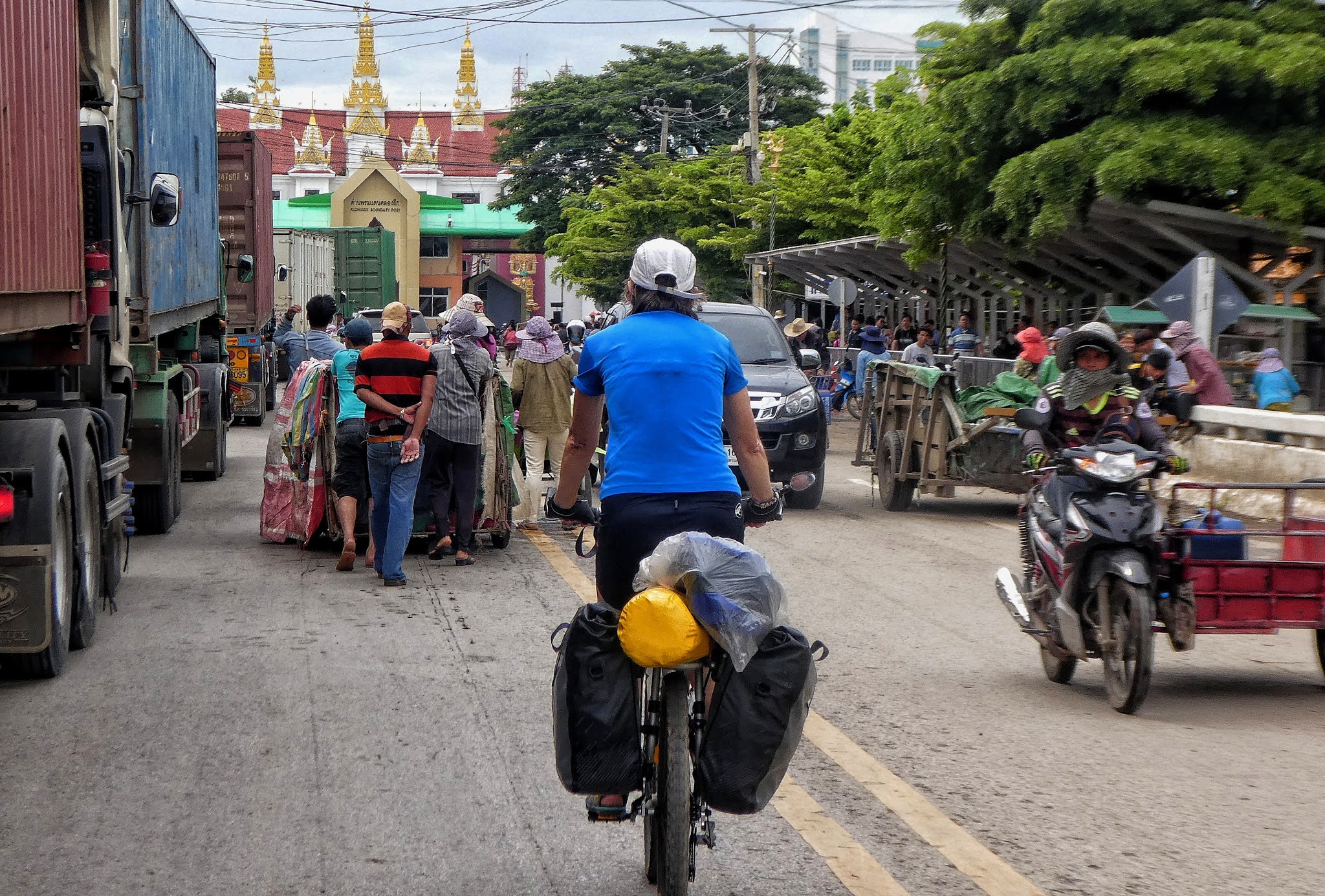
A short cycle took us to the Thai–Myanmar border via the Friendship Bridge, which spans the Moei River and looks exactly like the sort of place where officials might ask you to empty your pockets for no discernible reason. Once across into Myawaddy, we found ourselves in a scene that could best be described as “enthusiastically chaotic.” Dust swirled, tuk‑tuks buzzed, bicycle rickshaws wobbled, and trucks belched their way through the melee.

We needed new SIM cards and to change a few dollars—quite the challenge considering neither Linda nor I spoke a syllable of Burmese. Still, through a combination of pointing, smiling, and looking helpless, we managed. The Myanmar Kyat exchanged at 1,000 to the dollar, which meant I suddenly possessed a wallet thick enough to stun a small animal. I bought a new one specifically to hold the mountain of notes.

Together with minivans, buses, and what appeared to be the entire motorbike population of Myanmar, we cycled out of Myawaddy. The road over the mountain was steep but rewarded us with spectacular views. Mercifully, the weather was cloudy, sparing us from being roasted alive.

Once over the high point, we zoomed downhill into Kawkareik, where the Smile World Guest House offered rooms at the exorbitant rate of $20. The place was a dump, and the only one smiling was the owner—presumably at the thought of our money.

A walk into town revealed a beautiful Hindu temple and a lovely Buddhist one, but almost no food stalls. At the only open restaurant, the staff asked “Myanmar?” with great curiosity. We nodded, unsure what we had just agreed to. Eventually, a feast arrived: rice and an army of small bowls filled with mysterious dishes. Even with heroic effort, it was impossible to finish everything.


The Potholed Road to Hpa‑An (92 km)

Leaving our luxurious $20 palace, our first mission was to find breakfast. Roadside stalls offered little beyond fruit, which Linda bought. I opted for a bag of fried snacks—samosas, puri, and deep‑fried dough—essentially a portable heart attack. I was confident it contained enough calories to sustain me for a week.

To say the road was slow, bumpy, and potholed would be an understatement. We bounced along past rice fields where workers laboured gracefully and fishermen cast nets with enviable skill. Buses and trucks crawled along the narrow road, forcing us to snake around muddy holes like two determined slalom cyclists.

Towards the end of the day, the route deteriorated further, becoming either muddy or dusty depending on which section of road had given up hope most recently. Still, the scenery was sublime, and roadside stalls sold an impressive array of dried and fried fish—none of which looked remotely edible, but all of which were fascinating.

The humidity and poor road conditions made it an exhausting ride. With great relief, Hpa‑An finally appeared, offering accommodation that was substantially better than the previous night’s “Smile World” experience.


First Impressions of Mawlamyine (65 km)

An early morning walk through the market felt like stepping into a Kipling novel. Men with tanned faces and bamboo hats pedalled sidecars with flip‑flop‑powered feet. Others shuffled past with heavy bags of rice slung over their backs. Boy monks collected food, and women with painted faces sold fruit and vegetables. It was wonderfully atmospheric—and slightly surreal.

The ride to Mawlamyine was short and blessedly smoother than the previous day. A detour took us to the surreal Kyauk Ka Lat Pagoda, which balances precariously atop a limestone pinnacle in the middle of a manmade lake. It looked like something a bored god might have stacked for fun.

We continued past optimistic fishermen employing every imaginable method to catch dinner. The most successful were men snorkelling in rice paddies, spearing fish with bamboo contraptions that looked like they’d been invented on the spot.

We pedalled past rural hamlets where bare‑bum children played beside the highway and chickens pecked industriously at the dirt. Eventually, the road ended abruptly at a river. Fortunately, a tiny wooden boat appeared, ferried us across, and deposited us on a minor road leading to Mawlamyine—formerly Moulmein, famous for its pagoda‑adorned ridge.

The Sandalwood Hotel became our home for the night. After offloading our gear, we wandered separately. I strolled along the waterfront past crumbling colonial buildings and through the chaotic market, feeling as though I’d slipped back to 1826. Later, I climbed to the Kyaik‑Thanlan Pagoda, erected in 875 A.D. and said to house a relic of Buddha's hair. Afterwards, I met Linda, and we walked to the Mahamuni Pagoda before heading to the waterfront in search of dinner.


Mawlamyine

Mawlamyine was fascinating enough to warrant a full day. A morning walk through the market revealed the importance of chewing paan and using traditional makeup. While ancient societies worldwide have used face paint, few still apply it daily with such dedication. Nearly every woman—and quite a few men—wore it proudly. I found it delightful that both genders still wore the traditional sarong.

A tea house offered an excellent vantage point for watching life unfold. The clientele consisted mostly of longyi‑clad men with red, paan‑stained teeth, sipping sweet milk tea and chatting or reading the paper.

Later, we visited the enormous reclining Buddha located about 20 kilometres south of town—a structure so large it looked like it might roll over and crush a small village if startled.

The evening was spent strolling along the promenade and drinking beer at a local joint. Not a bad way to end the day.


Across the Tenasserim Plains to Thaton (70 km) 

Breakfast was included in the room rate, which always feels like winning a small lottery, even when the breakfast itself is only marginally edible. Once fortified, we headed toward Thaton, cycling past a parade of temples and golden stupa‑topped mountaintops that looked as though someone had sprinkled gold leaf across the landscape with reckless enthusiasm.

A short detour took us to a nearby waterfall—naturally with a stupa perched at the top, because Myanmar never misses an opportunity to place a religious monument somewhere precarious. After trudging up the stairs and snapping a few photos of the plains below, we returned to the bikes.

The ride to Thaton was blissfully flat, running across the Tenasserim plains. It was the sort of cycling day that makes you briefly believe you’re fitter than you actually are. We arrived early and checked into a basic guesthouse that was perfectly adequate, provided one didn’t look too closely at anything.

There wasn’t much to do in Thaton beyond walking to the Shwe Sar Yan Pagoda. It wasn’t the most spectacular Burmese temple, but it was pleasant enough and didn’t require climbing a mountain, which was a bonus. Our stroll back took us past a roadside restaurant with tables on the pavement—a perfect vantage point for watching Thaton’s daily life unfold while eating supper and trying not to get run over.


The Road to Kyaikto and the Golden Rock (70 km)

A good road led us to Kyaikto, where the conveniently located Happy Guest House lured us in with its promise of convenience rather than happiness. After offloading the bikes, showering, and grabbing lunch, Linda and I set off toward the famous Golden Rock.

Reaching the Golden Rock—also known as Kyaiktiyo Pagoda—required hailing a motorbike taxi to the base of the mountain, where enormous trucks waited to haul visitors up the steep pass. Each truck held about forty people, all packed in like produce being transported to market. Once full, the truck roared up the mountain with the reckless confidence of a vehicle that had never heard of brakes. Due to the gradient, no other vehicles were allowed up the pass, which was reassuring until you were actually on the truck.

At the top, a small community and three hotels clung to the mountainside. Fog rolled in with theatrical timing, and within minutes we could barely see each other. Still, we made our way to the Golden Rock, which balanced precariously on the cliff edge like a boulder attempting a circus trick.

The descent was by bus, no less terrifying, rattling down the mountain as though eager to reach the bottom before its bolts gave out.


Rural Detours and Lost Paths to Bago (119 km)

Breakfast was a lavish affair of fried noodles and egg—exactly the sort of fuel one needs before cycling 119 kilometres. Rural roads carried us past tiny settlements where time appeared to have paused sometime around 1953. Eventually, our path narrowed to a footpath and then ended altogether, forcing us to backtrack to the main road. This added several bonus kilometres to the day, which was not the kind of surprise one hopes for.

Upon reaching Bago, Linda located the Amara Gold Hotel, which was more than adequate and featured outdoor rooms that made loading and offloading the bikes wonderfully easy. After the day we’d had, this felt like luxury.  


Into the Old Capital

From Bago to Yangon, there were no rural routes, so we stuck to the motorway. As usual, the road was busy, and the closer we got to Yangon, the more the traffic resembled a slow‑moving stampede. Miraculously, we arrived unscathed.

Yangon is an ancient city founded at least a thousand years ago by the Mon people. According to legend, the Shwedagon Pagoda—its most famous landmark—was founded during the time of the Buddha. The city has since grown around it like a particularly enthusiastic vine.

Yangon is endlessly fascinating. Buddhist monks walk barefoot through the streets, men wear traditional longyi, and bicycle rickshaws remain a popular mode of transport. Colonial‑era buildings crumble elegantly, and the riverside location adds a certain charm that makes lingering irresistible.

The Sakura Tower, with its rooftop bar and restaurant, offered a perfect spot for a drink and a few photos of the city. Supper was at the aptly named Vista Bar, which provided a magnificent view of the beautifully lit Shwedagon Pagoda—glowing like a golden lighthouse guiding weary travellers toward dinner. 

The following day was spent in Yangon, a city with so many things to see and do that one could easily lose an entire week without noticing. We wandered, explored, stared at things, and generally behaved like two people with absolutely no idea where they were going but enjoying themselves anyway.


Leaving Yangon Behind - Okkan (101 km)

Getting out of Yangon was, once again, a nightmare. There was no alternative route—just the main road, which offered all the charm of cycling through a congested parking lot. Eventually, however, the city spat us out into the countryside, exactly where we wanted to be. Suddenly, we were back among familiar rice fields, lone monks, and fishermen who looked as though they had been part of the scenery for centuries.

Men in lungis pedalled bicycles with sidecars under bamboo hats, and women with painted faces sold wares from woven baskets balanced on their heads with the grace of circus performers. Parents squatted outside schools waiting to collect their little ones, and as always, the path led past Buddhist temples—some modest, others so lavish they looked like they’d been designed by someone with a gold‑leaf addiction.

Rudimentary houses and roadside stalls lined the way. Kids under umbrellas trudged home from school, and forgotten graveyards appeared at random intervals, adding a slightly gothic touch to the afternoon.

Lunch was a light affair from a roadside stall, and shortly afterwards, we rolled into Okkan, which offered surprisingly comfortable lodging. The staff were incredibly accommodating, and I had the distinct impression that not many foreigners chose Okkan as their holiday destination.


Easy Miles to Gyobingauk (93 km)

After breakfast, we pedalled on to Gyobingauk. The ride was effortless, mostly past rice paddies and temples, with occasional teeny hamlets and roadside stalls thrown in for variety. Gyobingauk itself didn’t offer much beyond a place to sleep, but its location halfway between Okkan and Pyay made it a convenient stopover. Sometimes practicality wins over excitement.


Along the Irrawaddy to Pyay (90 km)

The road to Pyay was flat and in good condition, making for easy pedalling. The area was rural, dotted with people fishing with rudimentary nets and paying respects at temples. Pyay welcomed us with the upmarket Hotel Irrawaddy, perched right on the river. A generous discount gave us a double room for $25—a bargain compared to other places and a welcome upgrade from the “functional but forgettable” lodgings of previous nights.


Sunrise Over Shwesandaw

There is something undeniably romantic about Myanmar. Perhaps it’s the vibrant colours, the hazy sunrises and sunsets, the women with painted faces, or the men in conical hats pedalling bicycles with sidecars. Maybe it’s the combination of all these things, woven together into a tapestry of gentle chaos.

Waking to the chanting of monks drifting across from the immensely impressive Shwesandaw Paya, one couldn’t help but fall a little in love with the place. Perched atop a central hill, Pyay’s Shwesandaw Paya is slightly taller than Yangon’s Shwedagon and dates from 589 BC—an age that makes even the oldest European cathedrals look like recent DIY projects.


Following the River to Aunglan (75 km)

We left Pyay as lady monks collected food, looking far more cheerful than their male counterparts. The road was rough but flat, leading us past beautiful scenes of rice fields under blue skies and colourful temples. Halfway through the day, the vegetation changed dramatically, becoming reminiscent of the Pampas in Argentina. Like the Pampas, this was cattle‑farming country.

Men on oxcarts greeted us cheerfully, while women in conical hats worked the fields with enviable efficiency. The road followed the Irrawaddy River, sometimes running flush beside it and at other times veering inland. Eventually, Aunglan signalled the end of the day’s ride.


Heat, Hills, and Hard Riding to Magway (140 km)

The stretch between Aunglan and Magway turned into one of those long, slow, soul‑testing cycling days when you begin to question all your life choices, including the one that put you on a bicycle in Myanmar in the first place. The road was bumpy, the hills were steep, and the heat was so oppressive it felt like cycling inside a malfunctioning oven.

Still, we churned our way up each hill with the grim determination of two people who had already come too far to quit. By the time we crawled into Magway, we were so exhausted we could have slept on a pile of gravel and called it comfortable.


A Long Glide to Chauk (120 km)

With legs that felt like they’d been replaced with damp noodles, we set off for Chauk. The first 90 kilometres were a gentle uphill, the kind that slowly drains your will to live, but the final stretch rewarded us with a steady downhill glide into town. Chauk offered a brand‑new establishment for $30, and we couldn’t have been happier. After the previous days’ trials, it felt like checking into the Ritz.


Into the Temple Plains of Bagan (45 km)

A short, effortless ride along a rural road led us to Bagan. The approach was lined with ancient temples, each one demanding at least one photograph, and possibly two. It was impossible not to stop and stare—Bagan has that effect on even the most jaded traveller.


Days Among the Pagodas

Bagan is said to have been the capital of the first Myanmar Empire, perched on the bank of the Ayeyarwady River and spread across 42 square kilometres. Built around 849 AD, it rose to prominence under King Anawrahta, who unified Burma under Theravada Buddhism. Over the next 250 years, rulers and wealthy citizens constructed more than 10,000 religious monuments. In 1287, the Mongols swept through and destroyed nearly all of them—because that’s what Mongols did.

Today, over 2,200 temples and pagodas remain, and I’m not exaggerating when I say they are everywhere. The people of Bagan live and work among these ruins; cattle graze between ancient stupas, kids play in dusty roads, and locals worship at temples older than most countries.

Bagan is magical—especially at sunrise and sunset, when the light turns everything gold and the whole plain looks like a dream someone forgot to wake up from.

Eventually, it was time to move on. A boat trip up the Irrawaddy River connected Bagan with Mandalay, sparing us a two‑day bicycle ride along a rough road. The boat also offered the chance to enjoy the mighty Irrawaddy, the country’s backbone and one of the most atmospheric rivers in Asia.


Mandalay — Monasteries and Gold Leaf

Gold leaf production is an ancient industry in Myanmar, and wandering the streets of Mandalay, I stumbled upon an alley where rhythmic pounding echoed like a giant heartbeat. Inside, muscled gold‑beaters hammered small packages with enormous hammers. I later learned that refined gold is liquefied, flattened, sandwiched between bamboo paper, and pounded for 30 minutes with 6‑lb hammers until it becomes the delicate gold leaf worshippers apply at pagodas. It’s a process that looks equal parts artistic and mildly dangerous.

Mandalay seemed to have an ancient monastery around every corner. Beautiful wooden buildings dating to the 1800s stood quietly, as though waiting for someone to admire them. The Shwenandaw Monastery was first—one of the most significant examples of traditional 19th‑century wooden architecture. Carved from teak, it was originally part of the Mandalay Royal Palace. When the capital moved, the building was dismantled, transported, and rebuilt as part of the new all‑teak palace in 1857. The amount of effort involved was staggering.

Equally impressive was the adjacent Kuthodaw Pagoda, situated on a 5.2‑hectare site and containing the entire Theravāda Buddhist scripture carved on 729 marble stelae—known as the “World’s Biggest Book.” Created between 1860 and 1868 by King Mindon, it is now included on UNESCO’s Memory of the World register. It’s hard not to feel humbled by a book you could literally walk through.

The last stop was the Shwe In Bin Monastery, built in 1895 by Chinese merchants. At the time of my visit, 35 monks lived there, and their chanting drifted through the grounds like a soundtrack to a very peaceful film.

At the puppet factory, I was astounded by the workers’ skill. Every puppet and every piece of clothing was handmade, and I could have spent hours watching them work. It was craftsmanship at its finest.

My final stop was the U Bein Bridge, said to be the world’s longest teak footbridge. Spanning Taungthaman Lake, it was wildly popular with tourists—though I didn’t see any other Caucasians exploring the area. The bridge and the fishermen would have made spectacular sunset photos, but sadly, I was too early. Timing, as always, is everything.


Storms on the Road to Meiktila (142 km)

From Mandalay, the plan was simple: cycle a leisurely 76 kilometres to Kume, check into one of the two guesthouses we’d confirmed the night before, and enjoy a relaxed afternoon. Naturally, Myanmar had other ideas.

We began with a stop at the U Bein Bridge, because one cannot leave Mandalay without paying homage to the world’s longest teak footbridge. The ride afterwards was effortless—one of those pleasant stretches where you briefly believe you’re a highly competent cyclist rather than someone who routinely forgets where they put their sunscreen.

Upon reaching Kume, however, both guesthouses suddenly announced they did not accept foreigners. This was delivered with the serene finality of people who had absolutely no intention of changing their minds. There was nothing to do but continue to Meiktila—another 75 kilometres away.

Fortunately, we were well‑rested, and the cycling was easy, at least until dark clouds gathered overhead with ominous enthusiasm. A loud crack of thunder signalled the beginning of a torrential downpour. A frantic scramble followed as we stuffed electronics into bags, after which we pedalled on with rain hammering down like an overzealous percussion section.

Eventually, the storm drifted off, leaving behind a mild tailwind that made the rest of the ride surprisingly pleasant. Seventeen kilometres from Meiktila, Linda suddenly pulled off the road. I wondered what catastrophe had occurred, but then realised she’d spotted a guesthouse. Rooms were $10, complete with air‑conditioning and hot showers. We couldn’t have been happier if they’d offered champagne and foot massages.


Southbound bus to Inle Lake

That evening, we discussed the route ahead and concluded that the main road offered very little of interest. Taking a bus to Inle Lake and spending our final days in Myanmar somewhere scenic sounded infinitely more appealing than cycling past another 200 kilometres of roadside dust.

A short ride took us to the Meiktila bus station, where minivans ran to Nyaung Shwe, the gateway to Inle Lake. Judging by the condition of our minivan, I doubted it would survive the steep mountain pass. It looked like a vehicle held together by hope and string. Miraculously, it made it—though we did stop twice for quick repair jobs that involved tools I’m fairly sure were not designed for automotive use.

The driver deposited us directly outside Inle Inn, which offered extremely comfortable accommodation for $18. By then it was late, leaving just enough time for a quick meal at the Indian restaurant before collapsing into bed.


Inle Lake, Nyaung Shwe - Fishermen at Dawn

I was up early, having arranged a boat to take me out on the lake for sunrise and, hopefully, a glimpse of the iconic fishermen. These “Leg‑Rowing Fishermen” of Inle Lake are famous for steering their boats with one leg. They stand on one leg, wrap the other around an oar, and somehow manage to fish with one free hand. It’s a manoeuvre that looks equal parts graceful and mildly impossible.

The sunrise was a disappointment—completely overcast, as though the sky had decided to take the morning off. Still, photographing the fishermen was great fun, even if doing so from a moving boat in low light felt like trying to take pictures during a minor earthquake.


Inle Lake - Festival Days on the Lake

We lingered around Inle Lake not only because it was wonderfully laid‑back—though it absolutely was—but also to experience the Phaung Daw U Pagoda Festival, one of Myanmar’s most famous celebrations. It lasts 18 days, which is impressive for any festival, especially one involving five Buddha images so thoroughly coated in gold leaf that they now resemble small, shiny dumplings rather than anything recognisably human.

A large ceremonial boat was constructed for the occasion, complete with a Golden Hintha (Hamsa) Bird figurehead that looked like it had been designed by someone with a flair for theatrical bird‑themed architecture. The Buddha images were placed on this barge and towed around the lake from village to village over the full 18 days. The towing was done by the leg‑rowers of Inle Lake, dressed in shiny, colourful costumes and rowing with one leg as though this were the most natural thing in the world.

Myanmar is home to around 135 ethnic tribes, and I learned that one of the oldest is the Padaung long‑neck tribe. They’ve managed to preserve many unique customs, including wearing stacks of brass rings around their necks. Legend has it that a tribe leader once dreamt a tiger would attack the community and break their necks, so he ordered all children to wear protective necklaces. The practice supposedly dates back to the 11th century. Contrary to popular belief, the neck isn’t actually stretched—the weight of the rings pushes the shoulders down, creating the illusion of a longer neck. These days, most rings are decorative and removable, which must make laundry day considerably easier.


The Long Bus Ride to the Border - Inle Lake to Myawaddy

We’d had so much fun at Inle Lake that we suddenly realised we needed to rush to the border before our visas expired. Tickets were arranged on the night bus, rumoured to be a direct service to the border. Rumours, as it turned out, were optimistic.

The coach left shortly after 16:00 and made it a grand total of 30 kilometres before grinding to a halt. Everyone watched with great anticipation as the driver produced a toolbox. After an hour of tinkering, the verdict was delivered: the bus was “kaput.” A replacement coach was summoned, and we all piled aboard like refugees from a mechanical disaster.

The ride was long and came without a toilet. If someone needed to use the bathroom, they simply asked the driver to stop, and the entire bus emptied out to “do the necessary” in the nearest available shrubbery. It was well past midday by the time we finally reached Myawaddy.

Linda and I unpacked the bicycles and pedalled to the Immigration Office, where we were stamped out of Myanmar. After waving the country goodbye, we headed to Thai immigration for our entry stamps and then returned to the First Hotel in Mae Sot. A meal and a beer were precisely what the doctor ordered.


Night Bus to Bangkok

We emerged at leisure and decided to spend the day in Mae Sot before taking the night bus to Bangkok. This gave us time to relax, wander around, and replace my mobile phone, which had reached the stage of technological decrepitude where even turning it on felt like an act of cruelty.

The ride to the bus stop was in the dark—a terrifying experience involving shadows, potholes, and the occasional stray dog with questionable intentions. The bus left at 20:00 and arrived at Bangkok’s bus station at 04:30. It was still pitch dark, but instead of waiting sensibly for daylight, we saddled up and headed into the city via a busy road. Reasonable people would have had a cup of coffee first. We, however, are not reasonable people. Miraculously, we made it to our guesthouse in one piece.


Farewell to the Road

I couldn’t sleep, despite having not slept all night. Eventually, I gave up and took a walk around the Khao San Road area before cycling to Bok‑Bok Bike for a service. Linda packed her bags for her midday flight to the Philippines, and just like that, another enjoyable ride in Southeast Asia came to an end.


Epilogue

Leaving Myanmar felt like stepping out of a vivid dream — one filled with painted faces, golden pagodas, and the steady hum of life along the Irrawaddy. Even as the bus rattled toward the border, the country lingered: monks at dawn, fishermen balancing on narrow boats, children waving from dusty roads.

Myanmar had been exhausting, exhilarating, and endlessly surprising. The roads tested us, the heat humbled us, and the distances stretched on, but the country gave back far more than it took. Back in Bangkok, with the city roaring around us, it was impossible not to feel a tug of nostalgia for the quiet mornings, the ancient temples, and the gentle chaos of the road.

It was a journey that left behind a simple truth: the world is always larger and lovelier than we remember — until we go out and meet it again.

Thursday, 20 September 2018

133 - 134-136 Vietnam to Thailand

 Pedalling With More Enthusiasm Than Sense


VIETNAM, CAMBODIA, THAILAND
1 September – 10 September 2018
6 Days – 702 km


PDF

FLIP-BOOK


Prelude


There are many sensible ways to explore Southeast Asia. One could take buses, trains, planes, or even stay home and watch documentaries narrated by people with soothing voices. I, however, chose the least sensible option: cycling. It’s a mode of travel that guarantees intimacy with landscapes, cultures, and potholes. Mostly potholes.

This chapter chronicles a stretch of that journey — a week of headwinds, border crossings, questionable snacks, and the kind of accommodation that makes you reconsider your life choices. It is, in short, a celebration of everything that happens when you travel slowly enough for the universe to notice you and have a bit of fun at your expense.


Vietnam


Saigon to Svay Rieng, Cambodia (125 km)

After cycling with Caron from Bangkok to Saigon, I had to make a beeline to Thailand, where I planned to meet my friend, Linda, as she was coming to Asia to cycle Myanmar.

Leaving Saigon on a Sunday morning, I had naïvely assumed the city would be taking a collective nap, allowing me to glide out gracefully. Instead, I found myself in a full-contact sport with motorbikes, buses, and pedestrians who seemed to regard traffic signs as decorative suggestions rather than binding law. I quickly adopted the local technique of ignoring everything except survival, which worked surprisingly well.

Eventually, Saigon shrank in my rear-view mirror, and I celebrated with one last ferry ride across a river. The romance of the moment was short-lived, however, as the opposite bank greeted me with a path so rough it felt like cycling across a field of Lego bricks. This charming detour spat me out at the Vietnam–Cambodia border, where I braced myself for the usual “special fee” negotiations. To my astonishment, the officials charged me only the official $30 visa fee—no extras “for their children,” “for the boss,” or “for the electricity bill.” I nearly fainted from the sheer honesty of it all.

With roughly 900 km ahead and only a week to cover it, I pressed on to Svay Rieng, where I found a $5 room that redefined the concept of “budget accommodation.” The mattress appeared to have been stuffed with gravel, the bathroom smelled faintly of despair, and the décor suggested the last tenant had been a goat. Still, one cannot expect the Ritz for the price of a sandwich. I consoled myself with the thought that beer and food were still within reach—and frankly, after that room, beer was not optional.


Cambodia


Svay Rieng to Phnom Penh (131 km)

Cycling out of Svay Rieng, I was immediately greeted by a headwind so determined it felt personal. Rice paddies drifted past at the speed of continental drift, and I began to suspect I might actually be pedalling backwards. Still, Cambodia has its charms, and on this day I stumbled upon the curious spectacle of flattened rice production.

The process is delightfully medieval: rice is roasted in a wok, then shoved into a wooden cylinder and pounded with a pole the size of a telephone mast. The hull is discarded, and what remains is eaten either dry (surprisingly tasty) or drowned in coconut milk, sugar, and banana. It’s essentially Rice Krispies with a tropical holiday.

Crossing the Mekong River was a revelation. The sheer volume of water rushing downstream was so vast I half expected to see Noah float past in an ark.

Arriving in Phnom Penh during peak-hour traffic and drizzle was like cycling into a blender. I eventually staggered into the Grand View Guesthouse, where I reunited with friends Matt, Dan, Chop, Phillipe, and Teresa. Several bottles of red wine later, I stumbled to my room in a state best described as “horizontal.” The next morning, I emerged with a headache so large it deserved its own postal code. Unsurprisingly, I went nowhere that day, though by evening the group had rallied enough enthusiasm for more beer.


Phnom Penh to Kampong Chhnang (108 km)

Leaving Phnom Penh, I attempted to avoid the main road, which is like trying to avoid sand at the beach. Along the way, I passed Wat Sowann Thamareach, a temple so unusual that it looked as if it had been designed by someone with a fondness for surrealist architecture. Carts laden with pottery trundled past, sold door-to-door like Avon products but heavier.

I even popped into the Vipassana Meditation Centre, where one can enrol in courses to achieve inner peace. I considered staying, but my schedule was tighter than my cycling shorts, so I pressed on.

Barely 12 km from Kampong Chhnang, dark clouds gathered ominously. I wondered if I could outrun the storm, and to my astonishment, I picked up a tailwind so strong I felt like I’d strapped a jet engine to my bicycle. Thunder roared, lightning streaked, and I flew into town just as the first raindrops fell, collapsing into a guesthouse with all the grace of a sack of potatoes.


Kampong Chhnang to Pursat (98 km)

I woke up feeling about as energetic as a boiled noodle, and the day proceeded with all the enthusiasm of a slow‑moving queue at the DMV. The road stretched ahead in a long, uninspired line, and I found myself drifting toward the market stalls for entertainment — which, in Cambodia, is always a gamble.

There were the usual trays of bugs, glistening in the sun like nature’s version of bar snacks. But then came the horror: skinned leopard cats. Yes, actual leopard cats, laid out as casually as tomatoes. These beautiful wild cats are regrettably hunted as food I stared at them in disbelief, wondering if Cambodia had collectively decided to skip straight past “endangered” and head toward “extinct.”

After that emotional rollercoaster, I was thrilled to roll into Pursat and find a room that was good enough to stay overnight. In Cambodia, “good enough” is a rating system unto itself.

The market offered heaps of fried crickets, which — in a moment of questionable judgment — inspired me to share a recipe. I understood that the first step is to refrigerate the crickets “until immobilised… to prevent your food from hopping away. This is, without question, the most polite way I’ve ever heard someone say “freeze your dinner so it stops escaping.”

Pan‑fry until crispy, season lightly, and voilà, you have a snack.


Pursat to Battambang (110 km)

This day was the cycling equivalent of being repeatedly slapped with a wet towel. A headwind blasted me with the persistence of an overeager hairdryer, and the road was in such appalling condition that it felt like riding across a corrugated roof. The road looked like it had been repaired by someone who had only ever seen asphalt in photographs.

Traffic roared past with all the courtesy of a stampede, and the lack of a shoulder meant I spent most of the day cycling in the unofficial “no‑man’s‑land” beside the road — a strip of earth that was technically not a road but was, somehow, still better than the actual road.

By the time I reached Battambang, I was ready to kiss the pavement in gratitude. Instead, I checked into Hotel Royal, which offered clean budget rooms. Clean! Budget! Two words that, when travelling, feel like winning the lottery.


Battambang to Aranyaprathet to Bangkok (130 km)

At this point, time was slipping away faster than my patience, so I pushed on to Aranyaprathet, where I abandoned the noble art of cycling and hopped on a train to Bangkok. Miraculously, taking a bicycle on the train was surprisingly easy. I half expected a bureaucratic nightmare involving forms, fees, and possibly a ceremonial blessing, but no — the train staff barely blinked.

Once in Bangkok, I pedalled to my usual guesthouse, ready for three glorious days of laundry, bike servicing, and pretending to be a responsible adult. My rushed departure from Aranyaprathet had been due to the looming Myanmar visa process. Nothing says adventure like paperwork.


Bangkok

Linda arrived after a 27‑hour flight from Fort Lauderdale, looking like she had been gently tumble‑dried. Still, after a considerable amount of chatting and beer, you both turned in. In my opinion, this is the correct way to welcome someone to Southeast Asia: hydration, conversation, and Chang beer.


Epilogue


Travel, especially by bicycle, is a strange and wonderful thing. It exposes you to landscapes, cultures, and culinary experiments you never asked for. It teaches patience, resilience, and the importance of checking your mattress for gravel.

This chapter ends in Bangkok, with laundry done, visas pending, bicycles serviced, and a friend newly arrived. Ahead lies Myanmar — a country of golden stupas, long roads, and undoubtedly more opportunities for misadventure.


But that, dear reader, is another chapter entirely.

Saturday, 1 September 2018

130 - 132 SOUTHEAST ASIA - CARON - Thailand (16.2) - Cambodia (7) - Vietnam (4) - 2018 - Caron


BANGKOK TO SAIGON
Thailand (16.2)- Cambodia (7) – Vietnam (4)
1 816 km – 29 days

2 August - 30 August 2018


MAP


PHOTOS - THAILAND (16.2)
PHOTOS - CAMBODIA (7)
PHOTOS - VIETNAM (4)


130 Thailand (16.2)

379 Km – 7 Days


2 August 2018 – Jomtien

Caron arrived in Thailand following an exceptionally long flight from South Africa via Singapore. We practically straightaway took a walk to the beach. A pleasant stroll along the ocean led to the night market where we drank the obligatory smoothie. Later, a few Chang beers were enjoyed before my jetlagged friend hit the sack.


3 August – Jomtien

Early morning, a short amble led to the beach to watch fishermen bring in their catch. Women not only had the job of selling what was brought ashore but prepared it right there, in case you liked your crab or fish already cooked. Caron was shocked at what was on offer, and I agreed seahorses shouldn’t be on the menu. After a swim in the ocean and noodle soup on the beach, Caron’s bicycle was reassembled, a job that went surprisingly smoothly. Then off to the bike shop to buy Caron a new pump and fit a headset extension - a move that would hopefully provide a more comfortable ride in the long run.

Lunch consisted of a typical red curry and spicy minced fish cooked in a banana leaf. Caron opted to have a homemade fruit salad consisting of rambutan, mango, mangosteen, passion fruit and banana. “Arroy mak mak,” as they say in Thailand.

By evening, we sought out the money changers before returning to the night market to do shopping and drink more smoothies.


4 August - Jomtien – 60 km

There wasn’t a great deal of rest as a decision was made to go the “no itinerary” route and thus wander off at random in the direction of Vietnam. As overnighting at temples was a real possibility, the Decathlon store was our first stop to purchase Caron a sleeping mat. At times, monks provided sleeping mats, but, in general, they avoid women like the plague and having one’s own mat was best to secure a decent sleep.

Our test ride through the countryside took us past substantial cassava plantations whilst sharing the path with broom and feather duster salesmen until reaching tiny of Ban Chak Ngaew. Ban Chak Ngaew is a community of Thai Chinese who still maintain their traditional lifestyle. A stand sold pineapples already cut accompanied by a sugar and chilli mix, unusual but surprisingly delicious on a hot day. The main street was lined with traditional Chinese wooden shophouses complete with ground floor shops and living quarters above. The nearby Hui Wei Sheng Niang temple is dedicated to a Hainan goddess worshipped by Hainanese worldwide.

Legend has it a fisherman named Pan, fishing out at sea, caught a block of wood which he threw back into the ocean. The next day he, nevertheless, caught it again. This repeatedly happened a few days, and Pan decided to take the block home. He felt the block had magical power and thus prayed to it, asking to be blessed with a great catch. He promised to build a temple to enshrine the wood if his prayers were granted. Pan’s prayer was granted, and he returned from his fishing trip, sporting a huge catch. Sadly, Pan didn’t have enough money to build a temple and forgot all about the promise made. The next day, his pigs became ill, and his neighbours saw a woman sitting on the branch of a longan tree near his house. This made him remember his promise, and on informing his neighbours of the incident, the community came together and raised funds to construct a temple and prayed for guidance as to where to build the new temple. Suddenly, a child came by and showed them where the temple should be constructed, and the first Hui Wei Sheng temple was built.

The temple was lovely, and the family taking care of it demonstrated how to ask for protection during our cycling trip. We lit a few incense sticks and banged the gong three times to alert the goddess of our wish. What a pleasant experience.

Our route took us towards the enormous Wat Yansangwararam temple complex. The complex is set in a vast park, housing several buildings of vastly different architectural styles, well-kept gardens, and a sizeable lake, making a peaceful setting. A steep staircase, flanked by a Naga balustrade, led to Wat Phra Phutthabat, the “temple of the Buddha’s footprint” which housed a footprint of Buddha, uncovered in Thailand in the 17th century. The place revealed a legend, but I’ll let it go this time as the story is becoming long-winded.

Our last stop was up a small hill, to the Khao Chi Chan (Buddha Mountain), a 109-metre tall carving of a seated Buddha on the side of a mountain. It made an impressive sight. A tailwind made easy returning to Jomtien to swim in the Gulf of Thailand, before a supper of green curry and Chang beer.


5 August - Jomtien - Nong Yai temple – 79 km

Woo-hoo, time to start cycling and I, was more than happy to get going and off to an unknown destination. Clearing the Pattaya City limits took the best part of the day. Luckily, our route soon spat us out on a considerably smaller path and amongst pineapple, coconut and rubber tree plantations. A stall sold cotton candy (roti saimai). Roti saimai (pronounced say may) is a Thai-style candy floss or cotton candy wrapped in a sweet roti. The thin silk strands are spun sugar and the strands usually come in a rainbow of colours. The crepe is very thin, and I understand the green is from pandan leaves. They were delicious and one couldn’t help but buy a whole bag full.

Still chewing on cotton candy, we stopped at a pineapple depo to watch workers load massive heaps of pineapples and were promptly given two large pineapples. Looking at each other in disbelief, we had no idea where to pack this generous gift. Finally, at our lunchtime noodle soup stop, one pineapple was gifted to the stall owner.

The remainder of the day was a pure pleasure, pedalling along an undulated section past rubber tree plantations where the cups had already filled with latex.

Tiny Ban Nong Yai was a typical small Thai village featuring wooden Chinese shophouses, mobile food carts, restaurants, and temples. On seeking permission from monks to sleep at the temple, they pointed us to a tiled undercover area. Good thing Caron bought a sleeping mat as a tiled floor can be hard. Supper consisted of minced pork topped by an egg, and I’d a distinct feeling the two farangs were the topic of conversation.


6 August - Nong Yai Temple – Sronlai Homestay – 62 km

The temple gong didn’t solely wake the monks and us, but the temple dogs, geese, chickens and birds. Taking the commotion, it was clearly time to wake up. Nevertheless, packing up remained a peaceful process listening to monks chanting their morning prayers. No doubt the monks were gifted a delicious pineapple.

Upon departing, the heavens opened. There was nothing to do but to continue until locating a stall to hide until the worse blew over. The stall owner was super welcoming and gave us a bunch of litchis, and on wanting to pay, she wanted nothing of it. The rain soon cleared, allowing us to continue. Our lack of breakfast made us feel nibblish. At the Bo Thong market, noodle soup was exactly what was needed and eaten to great enjoyment of the curious villagers.

The day turned out quite eventful as, on leaving Bo Thong, a massive bulge appeared along the wall of my tyre and a huge bang indicated the end of both tyre and tube. It happened in front of a simple eatery, and the immensely helpful stall owner gave me a lift on her motorbike to a motorbike/bicycle store. There I could purchase a new tyre and tube, albeit an extremely knobbly one. However, beggars can’t be choosers, and soon the new tyre was humming on the tarmac.

Stalls sold interesting snacks, as well as fruit. I couldn’t believe we bought a watermelon after our desperate attempt to get rid of the pineapples. The watermelon was tied on the back of Caron’s bike as the plan was on eating it later. A lovely ride led through dense forests and cashew plantations. On stopping to inspect this unusual fruit with its nut growing outside, the humble plantation owners came out to meet us. They were making charcoal and made time to show us the process. What modest and lovely people.

We encountered a few hills en route, typically featuring a shrine at the high point. These shrines were usually adorned with red Fanta soda bottles and a few flower garlands. Following taking a few pics in a rubber tree plantation, the next stop was at a dam. The dam had a lovely setting where one could camp and rent canoes, making a delightful end to an already enjoyable day.


7 August - Sronlai Homestay – Khao Chakan – 93 km

“We have to eat this watermelon,” Caron said, as she had no intention of carrying it an extra day. Breakfast was no doubt watermelon after which we followed a track via the dam wall, making a stunning morning ride. Dense forests lined both sides of the road, and butterflies and monkeys darted across our path while making our way through an elephant reserve. Regrettably, no elephants were spotted, merely dung, a sure sign they were in the vicinity.

The scenery was superb as we proceeded past bright-green rice paddies and water buffalo waddling in ponds left by recent rain. Fifty kilometres further, we stopped for our usual noodle soup lunch. Later, it started raining but as it was only a drizzle rain gear was donned before continuing to our planned overnight stop.

Despite the rain the ride turned out quite pleasant. On reaching Khao Chakan Forest Park, enough time remained to walk up to a cave via a near vertical staircase. Hundreds of monkeys played on the stairs and rocks, showing their agility. The stairs led to a massive hole in the mountainside, revealing stunning vistas of the surrounding landscape. The rain made the descent a tricky affair, wishing we were as agile as monkeys the walk down was a slow and careful one. Our accommodation was busses converted into guest rooms—quite a novelty. As always, when food shopping in the wake of a day of biking, far too much was purchased. Still, as the evening wore on, we miraculously managed to devour our entire supply of groceries.


8 August - Khao Chakan – Aranyaprathet – 85 km

Leaving our colourful bus accommodation, the way took us in the direction of Aranyaprathet where the plan was on crossing the border into Cambodia. Our chosen route ran through a highly rural area past old men herding water buffalo and village dogs attempting to give chase. Stopped at a small ice cream stall, about the entire community came out to greet us and little kids were unceremoniously dumped on Caron’s lap for a photoshoot.

A country lane led to Prasat Mueang Phai believed to be an ancient city dating from the Dvaravati era (6 - 11th century). According to what I read, Mueang Phai was a walled city that measured 1000 metres by 1300 metres and was surrounded by a 40-metre wide moat. Great was our surprise, therefore, to find simply a tiny heap of bricks and earth. However, this unsatisfactory discovery didn’t deter us. A short detour took us to Prasat Khao Noi believed built in the 12th century. This one was easier to find, and 254 steps later, we located the remains of three towers. Sadly only the middle one remained intact. In addition, an information board stated a lintel found on site dated to 637 AD but was quite likely re-used.

At the border town of Aranyaprathet, our laundry was handed in before rushing to the food vendors. The central pond and fountain acted as a night market and was surrounded by food vendors where one could pick from numerous dishes.

Dessert was “sankaya” or Thai pumpkin custard, a Thai-style pumpkin pie filled with lightly sweetened coconut milk and egg custard steamed inside a pumpkin. Quite delicious.

Ingredients

1 Kabocha squash (Japanese pumpkin)

10 Cups of water (for steaming)

4-5 Eggs

3/4 Cups coconut milk

1/3 Cup of coconut palm sugar

Pinch of salt

Pinch of cinnamon

1 tsp. vanilla extract


Preparation

Cut out the pumpkin like you would during Halloween. Cut out the top, remove all seeds and stringy insides.

In a mixing bowl, crack the eggs, add coconut milk, salt, cinnamon, vanilla and palm sugar. Stir well until the palm sugar is blended into the mixture.

Pour mixture into pumpkin.

Bring water to a boil in a steamer. Then place the pumpkin and the pumpkin lid inside the steamer basket. Don’t cover the pumpkin with the lid. Set the pumpkin lid in the steaming basket off to the side, so it cooks, too.


131 Cambodia (7)

954 Km – 16 Days


9 August - Aranyaprathet, Thailand – Roadside Guesthouse, Cambodia – 83 km

We cycled to the border where the border market and trade were already in full swing. The area was in complete chaos with traders in a mad rush to get to the market. We tried our level best to make our way through the hectic traffic. Eventually making it to the immigration office. After a quick stamp in the passport, we departed well-organised Thailand and entered a more chaotic Cambodia.

The entire way was congested with human-drawn carts, tricycles, three-wheeled motorcycles pulling heavily laden wagons, trucks, buses, and tuk-tuks all loaded to the hilt. It took weaving our way through dusty, bumper-to-bumper traffic, dodging barefoot monks and muddy puddles to the Cambodian emigration. A Cambodian visa came at $30 as per the embassy website. Hundred Thai Baht was nonetheless added to the price. (The Thai baht, I assumed, was what is known as “spreading the profit”)

From the immigration office, a good but dusty and congested ride took us east in the direction of Siem Reap. Numerous eateries lined the way and one such stall sold rice cooked in bamboo. Sticky rice is mixed with sugar, sweet red beans and coconut milk and then stuffed into cylinders of hollow bamboo. These tubes are then slow-roasted over coals, making a delicious snack.

The route made its way past bright green rice fields, wooden houses on stilts and friendly kids. Stopping to enjoy coconut juice was a fascinating affair involving meeting super-welcoming Cambodians. Wrinkly old ladies gave big toothless grins, and small kids shyly looked from behind their mother’s aprons at the two “farangs” (foreigners) in their midst. The day consisted of ambling along, marvelling at our new country, and passing men herding cattle and basic wooden houses where families were swinging in hammocks under stilted homes.

A sign pointed to a guesthouse, and to our surprise, we discovered a decent place offering a ground floor abode at $7. On taking a walk searching for a restaurant, we got plenty of stares and were observed with great interest. Even though no English was spoken, we managed to order food.


10-11 August - Roadside Guesthouse – Siem Reap – 85 km

Before heading to Siem Reap we first had coffee enjoying the fresh, morning air. The path was shared with broom and feather duster salesmen. Ornate temples jutted out forests and gave colour to paddy fields stretching as far as the eye could see. Fruit stands sold custard apples, and we bagged a few for the road. We biked on passing what we called “nursery carts” as these carts were stacked with plants and flowers, apparently heading to a market.

Our midday noodle soup stop caused a fair amount of interest from bystanders and people brought children to be photographed. Though, I’d a feeling the kids weren’t all comfortable with their new role as models.

Overcast weather and a tailwind made effortless pedalling, past water buffalo enjoying muddy puddles left by the previous night’s rain, and past ramshackle shops selling cigarettes and petrol by the litre. A market sold deep-fried snakes, frogs, and crickets. Caron couldn’t face trying these delicacies, and I merely tried the snake served with salt and lemon but thought it dry and tasteless.

Siem Reap was a bustling town swarming with tourists. It thus came as a shock to see the hordes of foreigners, fancy hotels, and upmarket eateries following a week in the countryside.

The next day was spent exploring world-renowned Angkor Wat, a fascinating experience.


12 August - Siem Reap – Sroyorng Koh Ke Guesthouse – 116 km

Cycling out of Siem Reap, I was surprised to witness child labour. Small kids on bicycles collected empty bottles to recycle. Being Sunday, I hoped they attended school during the week. Once out of touristy Seam Reap, the road deteriorated, making a bumpy ride through potholes filled from the previous night’s rain.

Rather than taking the highway, we opted for a significantly smaller route, hoping it would lead to the Mekong River. The ride turned out to be exciting along a dirt track and through the utmost of rural areas. Villagers still farmed in primitive ways, lived in nipa huts, obtained water from wells and chewed paan. Ox-drawn carts carted wares, rice was milled in backyards, and rice paper (used in Vietnamese rice paper rolls) were made by the entire family. Corn boiled in large pots at the roadside, and the aroma made it virtually impossible to cycle past. Unfortunately, our decision to buy what was on offer sent nearly the entire community in disarray. A few kids ran home, others giggled endlessly, but one brave soul remained and shyly served the two foreigners. The rain caught us no less than three times, each shower leaving us sopping wet with steam rising from our soaked bodies.

The area was nevertheless delightfully rural, kids played in rivers and jumped off bridges and did what kids do. Others were cutting rice in paddies, and village dogs made it clear this was their territory. A pleasant day by anyone’s standards made even more so by finding a guesthouse in a tiny nameless settlement.


13 August - Sroyorng Koh Ke Guesthouse – Chhaeb – 110 km

Child monks collected food as we biked out of the village. Our path twisted and turned through rural settlements where cattle and buffalo had the right of way. Like the previous days, our route was shared with two-wheel tractors pulling wooden trollies laden with produce or entire families. Friendly kids called “hello”, and pyjama-clad women waved us goodbye.

Motorbike salesmen were carting piglets in bamboo cages and others woven fish traps. But, highly fascinating was a mobile separating rice milling machine (not sure what it’s called). It went from house to house and separated the villager’s rice from the husk.

Fearful kids hid behind their mothers’ aprons and small dogs ran for their lives, only stopping once they reached the safety of their homes. This was a clear indication few foreigners ever ventured that way. The way ran amongst the ever-present luminous green rice paddies and past small kids, three up, on small bicycles. Finally, towards the end of the day, Chhaeb rolled into view.

Little English was spoken in those rural areas. Still, getting a bite to eat was easy. All one needed to do was repeatedly point your second and middle finger to your mouth (indicating chopsticks). What was served was often a surprise. This time, it consisted of a clear broth containing chicken feet, rice, and a meat dish that primarily included bones. What bones they were, remains a mystery. Still feeling slightly hungry, we stopped at a stall to pick up a noodle dish. Waiting, Caron ordered a boiled egg and to her horror, the egg turned out “Balut” - a half-developed duck embryo. Needless to say, the dogs enjoyed it.


14 August - Chhaeb – Stung Treng – 86 km

Our first stop was at a baguette stand. Cambodia’s traditional snack, Nompang (baguette), is filled with slices of pork, meatloaf, pickled carrots, papaya, and cucumber, topped with coriander and a pate spread. It’s delicious.

Then, on to our final stretch to the Mekong. It must be mentioned this was an extremely rural area where foreigners seldom ventured. Even though friendly, children were, for the most part, highly apprehensive and kept their distance. Vendors sold meagre supplies of petrol by the litre, and a few fruit and vegetables from their gardens. Also sold were birds and other wildlife in cages including a baby monkey who befriended a dog (as if they knew they were in the same boat as both were for sale).

Still, even the tiniest hamlet had a pharmacy and a small clinic, consisting of no more than a few bamboo woven beds. The beds weren’t unusual as, in general, people in southeast Asia sleep on woven rugs. Soon afterwards, it started raining. A ramshackle stall made a good cover and place for a tasty barbequed sausage and baguette snack. I considered it best not to enquire regarding the ingredients. Whilst waiting until the weather cleared, we watched ladies pounding rice to make tepung, a kind of rice flour. As in Africa, two women rhythmically pounded rice into fine rice flour in a large wooden trough using long poles, hypnotic and relaxing watching.

Crossing innumerable broad rivers and watching skilful fishermen cast their nets, the path crossed the Mekong River via the modern Stung Treng Bridge. The town sported several guesthouses and finding accommodation was straightforward. Although right in the market area, we were unsuccessful in finding food and eventually settled for a fried noodle dish from a Chinese restaurant.


15 August – Stung Treng – Krati – 142 km

Hou boude, hou,” Caron said when I told her the ride to Krati would be 140 kilometres, the next settlement along the Mekong. Unfortunately, the area didn’t offer a great deal in line of accommodation or even temples, and one had little option but to continue. A bumpy and potholed route led out of Stung Treng. Mercifully, about 40 kilometres later, a brand-spanking-new road, made riding far more comfortable. The weather was overcast, but a slight headwind slowed our pace.

Even though a challenging day, it remained a privilege and a pleasure to cycle past small settlements where cattle, bare-bum kids and buffalo had the run of the village. A lunch of fried rice from a roadside stall provided much-needed energy.

Basic wooden houses on stilts, welcoming Cambodians, and laundry flapping on fences became familiar scenes. For the best part of the day we’d our heads down as we pedalled across enormous rivers, past rice fields and forested areas until reaching Krati in a slight drizzle and fading light. Exhausted, and Caron with a sore behind, the Heng Heng Hotel, right on the Mekong River, was a welcome sight. However, no sooner settled in, a fierce storm rolled in, rattling windows and doors, and we couldn’t believe our luck. Once the storm had subsided, hunger pains drove us to a nearby restaurant where we could choose from an extensive range.


16 August – Krati

We woke to the sounds of the street and a view of the Mekong River. As we’d plans of tracking down the rare freshwater river dolphins, there was no rush to go anywhere. A walk through the market was as interesting and informative as all markets, and it gave a glimpse into the lives of ordinary Cambodians. Who said pyjamas was purely for bed? In Cambodia, this comfortable garment has evolved into all-purpose wear. Pyjamas were worn by Khmer women at all times of day - to markets, on the streets and even to restaurants. We, therefore, followed suit and Caron bought herself decent Cambodian pyjamas she planned on wearing riding.

A bumpy tuk-tuk ride dropped us where boatmen took people across a strong-flowing Mekong River to where we hoped to catch a glimpse of the river dolphins. Irrawaddy dolphins are distinctive in that, unlike nearly all species of dolphins with long noses and pointed features, the Irrawaddy species has a blunt nose and straight mouth, rounded tail and fins. In addition, they don’t jump like other dolphins, and one had to look closely to see them. It’s said that these dolphins are genetically related to the killer whale (orca). How interesting! Although called the Irrawaddy River dolphin, I understood that they are not actual river dolphins. Instead, they are oceanic dolphins living in brackish water near coasts, river mouths, and estuaries. It has established subpopulations in freshwater rivers, including the Ganges and the Mekong. These dolphins are highly vulnerable as the worldwide population appears around 7,000. Another interesting fact is that they are almost blind. They have tiny eyes and even lack lenses and can do little more than distinguish between light and dark. What a fascinating world we live in! Finally, with threatening weather, our boatman returned to the safety of the shore.


17 August - Krati – Police station – 83 km

From Krati, a narrow, rural track ran along the Mekong, a beautiful ride through small settlements on the river banks. Flooding is a way of life along the lower Mekong. In August/November, monsoon rains fill the river, spilling over into adjacent farmlands. Our route was chock-a-block with livestock, laundry and children; all brought to the elevated road for safety. If your house wasn’t on high stilts, things were sure to become wet. Schools, temples, mosques and even clinics were all under water. Yet, no one seemed stressed and kids enjoyed the abundance of water.

Pyjama-clad women sat in doorways nursing babies or playing with toddlers. At the same time, men on haunches fixed fishing nets and bamboo chicken cages. Eateries moved onto the slightly elevated road which made convenient pickings. The path meandered through the chaos until reaching where the map indicated a guesthouse. Regrettably, the place didn’t exist and at the temple, monks pointed us to another temple. The temple was a busy one occupied by child monks and village kids. Understandably, they were inquisitive, but this well-meaning attention was overbearing to us. In the process, a kind Cambodian offered accommodation in his house but, again, we found sharing sleeping quarters with an entire family too close for comfort and continued to where we came upon a police station. Helpful staff phoned the “director” who gave the necessary permission. After presenting our passports and lining up for a photo (which made us feel and look like two criminals), the staff pointed to a vacant office. Under scrutiny, we swept the office and rolled out our sleeping mats. Our every move was watched until we eventually indicated our need for privacy and our hosts returned to their office. Caron wasn’t too happy sharing our spot with frogs, crickets, grasshoppers and geckos and once they were gently helped outside, we settled in.


18 August - Police station – Kampong Cham – 48 km

Caron claimed she slept keeping one eye open, watching for our four-legged “roommates”. Following a photoshoot, we cycled south in the direction of Kampong Cham. Still early, we found villagers going about their daily tasks. Kids were off to school, and ladies in pyjamas sold fried dough from the back of bicycles, which made a great snack cycling.

Like the previous day, low-lying areas were flooded, sometimes only rooves of barns or houses could be seen. Kids loved it and had a ball playing with anything that would float. The slightest elevated areas were used to dry produce, cook or keep chickens and cattle out of harm’s way. As grazing areas were flooded, feed was collected elsewhere, and ladies on bikes carted animal feed. At the same time, men toiled the land using oxen. The river trail was one of my favourite rides, and thoroughly enjoyable as we made our way to sleepy Kampong Cham. The evening was spent strolling along the riverfront in the company of the people from Kampong Cham, as this was where they hung out at sunset.


19 August – Kampong Cham –Phnom Penh – 110 km

From Kampong Cham, a small track took us along the river and went past people living on barges; several even had small gardens. Ladies were dyeing silk (used in weaving) or were drying grasses in the sun. These colourfully dyed grasses made pretty pictures as well as beautiful mats. Salesmen stacked high sold wares from door to door and bicycles piled equally high with animal feed were on their way home. Small kids, no more than four or five years old, gave friends a ride on their tiny bikes. Their balance on a bicycle is extraordinary.

Due to flooding, our route ended abruptly, forcing us to find an alternative path. Unfortunately, a typical monsoon storm came in. We pulled into the nearest sheltered area, only to find it a private house. In typical Cambodian style, the family welcomed us and offered chairs to wait out the weather.

Once the worse was over, we set out anew, soon reaching the highway leading into Phnom Penh. Being Sunday afternoon, we’d an (almost) leisurely ride into the city. Once at Grand View Guesthouse, I was delighted to meet my adorable friends Chop, Matthew, Phillipe, Nic and a few others.


20-21 August - Phnom Penh

Priority was to obtain a Vietnamese visa and a tuk-tuk ride took us to the Vietnamese embassy merely to find it closed. There was zero one could do and we returned to our abode. Caron visited the killing fields and the old S21 detention centre. I chatted to my friends and caught up on outstanding matters. We handed over our passports to a visa agency as we had limited time available. At a small fee, they arranged a Vietnamese visa in 24 hours. During our stroll along the riverfront, we were cajoled into a sunset cruise and at $5 pp, we were easily swayed. The evening turned out lovely as the boat slowly sailed upriver at sunset and we, glass of wine in hand, sat back and enjoyed it all.

The next morning, we searched for dumplings uncovered outside the central market. Afterwards, we felt well-fed and strong enough to brave the market. We weaved through a labyrinth of stalls in the hunt of nuts and other delicacies to concoct a snack to eat during the day. Tickets were bought to that evening’s traditional dance show which made a lovely evening out.


22 August — Phnom Penh — Angkor Borei (Borey) — 91 km

Getting out of Phnom Penh was easier than anticipated. The initial plan was to head to Neak Loeung, but 20 kilometres outside the city, a change of plan made us head to Angkor Borei. A stunning ride proceeded through a seldom visited and rural part of Cambodia. The way varied from exceptionally rough and potholed to smoothly paved. Just as one became used to the comfort of a paved road, it abruptly ended and turned into a rough dirt track past duck farms and people on motorbikes laden with bananas. These motorbikes were fitted with frames allowing transporting a maximum load. At a water stop, the owners promptly invited us in and even offered accommodation. Too early to call it a day we continued to where a ferry took people across the Tonle Bassac and continued on a rough track, past farmers drying rice.

Certain crops were ready to be harvested, others were planted more recently. Lunch was at the small community of Prey Lovea, and then on to Angkor Borei an area continuously inhabited for at least 2500 years. Artefacts unearthed in the area dates from the Neolithic period between the 4th - 5th century AD and the Angkorian period (9th - 15th century AD). Nevertheless, there was no sign of its past glory. In tiny Angkor Borei finding a guesthouse was easier than food, eventually, we settled for ordinary fried noodles, but would’ve been happy with almost anything dished up.


23 August - Angkor Borei - Kampot

From Angkor Borei, we understood a boat ferried people to Takeo, saving biking a long distance around the lake. Since no one spoke English, the procedures or time weren’t entirely clear. The lady at our digs spoke a little English, and reported a boat departed at 7h00. Adjacent to the temple, we located a slipway and the official Angkor Borei/Takeo ferry. Once the bikes and panniers were loaded, more passengers started arriving. We claimed the front seat and waited until the boat filled up.

No sooner were the boat underway when the engine cut out, leaving the boat adrift. Thankfully, they simply wanted to drop a passenger. The skipper sped across the lake at high speed, drenching the two unsuspecting “farangs”, and we then understood why others filled the boat from the back. Barely an hour later, we arrived in Takeo, soaking wet.

A slow leak made me stop at a bicycle shop to buy a new inner tube as I’d neglected to fix the punctured ones. The shop had none in stock, and I started fixing the old tubes, a job the owner took out of my hands as he most likely thought I’d no idea what I was doing. I didn’t resist, and he fixed both tubes. He wanted no payment and further supplied us with a stack of patches. Before cycling out of Takeo, breakfast was pork pau and iced milk tea, usually delicious. Still, we were served a glass of condensed milk over ice. Even though strange, we drank it anyhow. The owner subsequently showed us we were to add the tea (already on the table) to the milk! He most likely thought, “Stupid foreigners, which we were”. Being already late, we made our way to the main road which took us in the direction of Kampot.

The path followed was a rough one and once on the main road the going was considerably easier. Battling a headwind and becoming drenched on three occasions made slow progress. The rain was a blessing to the farmers, and rice paddies were filled to the brim. It’s never a pleasure riding into a headwind, and we had 70 kilometres of that. Little did we know the worse was still to come.

Approximately 18 kilometres from Kampot, the road deteriorated to such an extent it became easier to cycle next to it. Traffic snaked around potholes as best they could, a futile attempt as ongoing roadwork made it one giant pothole and, therefore, a dusty and slow affair.

Thrilled to arrive in Kampot, we headed across the river to Riverside Bungalows, where guests laughed at our dirty, dusty faces. On removing our shades, we resembled two Silverleaf monkeys. Following a shower, it was time for a well-deserved beer and a massive plate of food.


24 August – Kampot

Kampot River Bungalows was an ideal place to enjoy a day of leisure. Situated in a jungle-like setting, it featured nipa huts on stilts overlooking the river. It made a peaceful and tranquil location. Cabins were extremely basic and airy, but mercifully came with mosquito nets.

Inner tubes made perfect toys with which to float on the river. The restaurant deck extending over the water was an excellent place to while away the time. Later, a short cycle led into Kampot, and once stocked up on snacks, we returned to our little haven. Supper was on the deck overlooking the river. Life was indeed good behind the potted plants.


132 Vietnam (4)

483 Km – 6 Days


25 August - Kampot, Cambodia – Ha Tien, Vietnam – 75 km

From Kampot, and on a bumpy, dusty route, the way to Vietnam weaved through rice paddies, palm trees and basic houses under corrugated iron roofs, to the small seaside village of Kep. From Kep, we made our way along a rural path to the border through an area where the air smelled of cow dung, and typical homes kept cattle in front yards. Nevertheless, our last day of riding in Cambodia was a relaxing one watching ladies cutting rice and kids collecting snails in rice fields.

The Hungry Ghost Festival was being celebrated and shrines were stacked with tins of beer and cigarettes. At the full moon of the seventh lunar month of the Chinese calendar, it’s believed the gates of hell open, and spirits of hungry ghosts are allowed to roam Earth. Naturally, these ghosts need food and people help by offering food, paper money, candles, and flowers. We watched villagers burning paper offerings in an attempt to appease the ghosts.

On arrival at the Cambodian/Vietnam border, crossing into Vietnam was a smooth affair. Our first stop was at a cave temple, reached following climbing a few stairs. The cave was surprisingly airy inside and offered grand vistas of the surrounding landscape.

Our first town in Vietnam was one with a fascinating history. Way back, Ha Tien was a Cambodian province. Still, under the attack of the Thai’s in 1708, the then-governor, Mac Cuu, approached Vietnam for assistance. Assistance was granted after which Mac Cuu governed the area as a fiefdom. Sadly, this wasn’t the end of their struggle. Since then, they’ve been invaded by Thais on several occasions and came under attack during the American war and during the reign of the Khmer Rouge, who massacred thousands of civilians living in Ha Tien at the time. Today, though, Ha Tien is a peaceful town sporting a lovely river setting, a lively day market, and an interesting night one.

Trying to change money was easier said than done, as no one spoke English and banks were closed. However, one could typically get a better rate at the gold shops. With a whopping 2,000,000 Vietnamese Dong (approx. $85) in our pockets, we felt rich and booked into an establishment right on the river.


26 August — Ha Tien — Chau Doc — 103 km

It was a pleasure to wake to the sounds of the street and the general mayhem of the market. I sipped my first cup of coffee listening to ferries blowing their horns before departing to the islands - a pleasant way to greet the day. Before getting underway breakfast was at the market. It consisted of a typical Vietnamese Pho (noodle soup), the first of many.

Our path followed a canal close to the Cambodian/Vietnam border and a way congested with motorcycles and minivans running to and from Cambodia. It, nevertheless, remained a pleasant ride, and rains transformed the delta into what looked like an ocean. At times, the canal completely disappeared, but amazingly boats still managed to find their way. River transportation was alive and well in Vietnam, and so was the farming of birds’ nests. These edible birds’ nests are created by swiftlets using their saliva to build them. The nests are extremely popular in Chinese culture not unlike caviar in the west. Its popularity is due to its rarity and supposedly high nutritional value and flavour. I subsequently read, these nests are among the costliest animal products consumed by humans, with nests selling at prices up to US$3000 per pound, depending on grading. With those numbers in mind, it’s understandable why farmers build massive structures specifically for these birds to nest.

Roadside markets sold woven baskets and mats, and peasants collected plastic bottles and tins to recycle. In Vietnam, eateries came with tables and chairs and a considerable number of hammocks, as it is unthinkable to sit when one could lay, which made complete sense. We followed suit, kicked back in a hammock, and replenished our thirst with coconut juice.

With the recent flooding farmers had nowhere to dry their rice crops. They used the tarmac, forcing vehicles over it to assist in the threshing process.

The Ba Chuc memorial was a grim reminder of the horrors perpetrated by the Khmer Rouge. In April 1978, the Khmer Rouge killed 3157 villagers in Ba Chuc; only two survived. A depressing visit. Outside, a lady sold what I would call Vietnamese pizza (Banh Trang Nuong). It consisted of rice paper grilled on coals and topped with chilli paste, quail eggs, spring onions, and minced pork. Delicious.

The trail petered out altogether forcing us to return to our original route. Caron was a star and never complained once about the detours or terrible conditions. Once in Chau Doc, the comfortable Thuan Loi Hotel right on the river was a perfect choice.


27 August - Chau Doc – Cao Lanh- 75 km

Our balcony overlooked the Bassac River, a perfect vantage point to watch all happenings. Not simply did large boats move up and down the river, but people rowed kids to school or themselves to work or markets. All this happened whilst the river was in full flood, and one could only be amazed at the skilful way they did it. Our route left via a small path and we made our way along one of the many canals. In the process, we passed ladies under straw hats pushing carts laden with fruit and vegetables from door to door.

The delta is a watery world. Here, the Mekong River drains into the South China Sea, ending its 4,350 km journey from Tibet through Myanmar, Laos, and Cambodia. No less than four times ferries were required to get across the many waterways and canals, all making an unforgettable day. Roads were generally tiny and villages small and rural, and the larger ones were congested with motorbikes and scooters.

Having a bite to eat at a restaurant, I was surprised to see a man and his chicken having lunch. I’m not kidding you. There he was, with his chicken sitting next to him on a chair. On his departure, he tucked the chicken under his shirt, got on his motorbike, and sped off. A river trail ran along the canals from our lunch spot, making a good day on the bike.


28 August - Cao Lanh – Vinh Long – 70 km

“I think we’ve doubled the tourist count of Cao Lanh,” Caron said as we sat down to an excellent bowl of Pho. Pho is a Vietnamese soup consisting of broth, rice noodles and meat and is considered Vietnams national dish. Ambling along, we were perplexed by the drying of water hyacinth. As far as I was aware, barely any use existed for this extremely invasive and free-floating aquatic plant. I couldn’t imagine what it could be used for.

The Xeo Quyt forest was a magnificent 52-hectare forest and swamp. I understood it was one of the last natural forests in the Mekong Delta. During the Vietnam War (1955-1975), the area was used as a base, and today it hides the remains of Viet Cong bunkers. Paddling through a thick canopy of trees past remains of war relics made fascinating exploring. Moreover, it gave a tiny glimpse into the lives of Vietnamese during that time.

Finally, I discovered the use of dried hyacinth. Resourceful Vietnamese were using it to weave baskets and various other products. After ice cream, we turned our iron horses in the direction of Vinh Long. Once there, we opted for a short ferry ride to an island where a homestay owner showed us the way to his guesthouse. The evening turned out interesting as the establishment was brand-new, and still in the process of being built.


29 August – Mekong River Homestay – My Tho – 85 km

Breakfast included a delicious cup of Vietnamese coffee; the best had until then. We wished the family good luck with their new venture and cycled to the ferry. The boat was packed with farmers and traders taking produce to the market. It was astonishing to watch the skilful way they manoeuvred their motorcycles onto and off the ferry.

Our route continued along a river, passing villagers selling simple homemade nibbles. Others were winnowing rice the old-fashioned way or drying homemade sausage in the sun. Beautiful temples and interesting-looking brick-making structures made interesting detours. Each area in the delta produced a different crop, and we were very much in the area of dragon fruit plantations.

The delta came with countless ferry crossings and bridges. Rivers were busy waterways, and all boats had eyes painted on the bows. Fishermen and seafarers of all countries are superstitious, and the Vietnamese were no exception. Some say the eyes are intended to help the boats at sea find their way back to land. Others say the eyes are meant to scare off sharks or water monsters or are meant to bring good luck and fortune. Several fishermen believe their boats are like fish – with souls and eyes to steer clear of danger. Whatever their purpose, eyes adorned boats, both big and small. I understood painting eyes on a ship was an important ritual often associated with a ceremony to “open the eyes” of the vessel and bring it to life. I could relate to this as back home, before a dragon boat race, a ceremony known as “Awakening the Dragon’” or “Dotting of the Eye”, was performed, thus ending its slumber.

On arrival in My Tho, a helpful man pointed us to a budget hotel right across from the night market. It suited us perfectly and once showered, we hurried to the food court, where one could sit overlooking the river. Watching the Mekong flow past was a fitting end to the day and our ride through the delta.


30 August - My Tho – Saigon – 75 km

Breakfast was a pavement bánh mì (Vietnamese baguette). There was banh mi stands on practically all streets in Vietnam. The baguette featured crispy bread, with a tasty filling of sliced pork, pate, chicken, egg, spicy chilli sauce and herbs. We ate our baguette, dripping sauce over ourselves and the pavement (I don’t know how the Vietnamese do it), watching the horrendous morning traffic. Then, with full bellies, we joined the mass of motorbikes and resumed our ride out of My Tho. The ride turned out more pleasant than expected as we encountered rural paths leading virtually all the way to Saigon.

The route led through farming communities where women with conical hats sat on their haunches cooking. Chickens pecked in the dirt and men carted huge piles of hay on small motorcycles. The aroma of homemade food drifted across our path as school children headed home to have lunch. Our route meandered through dragon fruit plantations until reaching the city limits. We joined the eight million motorbikes in Saigon, into the city. Following suit, we didn’t look left or right and ignored red lights and road signs, eventually reaching downtown. In one of the alleys, we located Hai Guesthouse with a spacious room and large balcony. The strange thing was virtually everyone referred to the city by its old name “Saigon”, instead of TP Ho Chi Ming city. The only one’s referring to it by its proper name seemed the officialdom.

Sadly, this was the end of our journey. From Saigon, Caron returned home, and I’d to make a beeline to Thailand. I planned to meet my friend, Linda, in Bangkok, as she was coming to Asia to cycle Myanmar. It was a pleasure cycling with Caron, and I hope she enjoyed her time in Southeast Asia. Go well, my friend.