BANGKOK
TO SAIGON
Thailand (16.2)- Cambodia (7) – Vietnam (4)
1
816 km – 29 days

MAP
PHOTOS - THAILAND (16.2)
PHOTOS - CAMBODIA (7)
PHOTOS - VIETNAM (4)
130 Thailand
(16.2)
379 Km – 7
Days
2 August 2018 – Jomtien
Caron arrived in Thailand
following an exceptionally long flight from South Africa via Singapore. We practically
straightaway took a walk to the beach. A pleasant stroll along the ocean led to
the night market where we drank the obligatory smoothie. Later, a few Chang beers
were enjoyed before my jetlagged friend hit the sack.
3 August – Jomtien
Early morning, a short amble
led to the beach to watch fishermen bring in their catch. Women not only had
the job of selling what was brought ashore but prepared it right there, in case
you liked your crab or fish already cooked. Caron was shocked at what was on
offer, and I agreed seahorses shouldn’t be on the menu. After a swim in the
ocean and noodle soup on the beach, Caron’s bicycle was reassembled, a job that
went surprisingly smoothly. Then off to the bike shop to buy Caron a new pump
and fit a headset extension - a move that would hopefully provide a more
comfortable ride in the long run.
Lunch consisted of a
typical red curry and spicy minced fish cooked in a banana leaf. Caron opted to
have a homemade fruit salad consisting of rambutan, mango, mangosteen, passion
fruit and banana. “Arroy mak mak,” as they say in Thailand.
By evening, we sought out
the money changers before returning to the night market to do shopping and drink
more smoothies.
4 August - Jomtien – 60
km
There wasn’t a great deal
of rest as a decision was made to go the “no itinerary” route and thus wander off
at random in the direction of Vietnam. As overnighting at temples was a real
possibility, the Decathlon store was our first stop to purchase Caron a
sleeping mat. At times, monks provided sleeping mats, but, in general, they avoid
women like the plague and having one’s own mat was best to secure a decent
sleep.
Our test ride through the
countryside took us past substantial cassava plantations whilst sharing the path
with broom and feather duster salesmen until reaching tiny of Ban Chak Ngaew.
Ban Chak Ngaew is a community of Thai Chinese who still maintain their
traditional lifestyle. A stand sold pineapples already cut accompanied by a sugar
and chilli mix, unusual but surprisingly delicious on a hot day. The main
street was lined with traditional Chinese wooden shophouses complete with
ground floor shops and living quarters above. The nearby Hui Wei Sheng Niang
temple is dedicated to a Hainan goddess worshipped by Hainanese worldwide.
Legend has it a fisherman
named Pan, fishing out at sea, caught a block of wood which he threw back into
the ocean. The next day he, nevertheless, caught it again. This repeatedly
happened a few days, and Pan decided to take the block home. He felt the block
had magical power and thus prayed to it, asking to be blessed with a great
catch. He promised to build a temple to enshrine the wood if his prayers were
granted. Pan’s prayer was granted, and he returned from his fishing trip, sporting
a huge catch. Sadly, Pan didn’t have enough money to build a temple and forgot
all about the promise made. The next day, his pigs became ill, and his
neighbours saw a woman sitting on the branch of a longan tree near his house. This
made him remember his promise, and on informing his neighbours of the incident,
the community came together and raised funds to construct a temple and prayed
for guidance as to where to build the new temple. Suddenly, a child came by and
showed them where the temple should be constructed, and the first Hui Wei Sheng
temple was built.
The temple was lovely,
and the family taking care of it demonstrated how to ask for protection during
our cycling trip. We lit a few incense sticks and banged the gong three times
to alert the goddess of our wish. What a pleasant experience.
Our route took us towards
the enormous Wat Yansangwararam temple complex. The complex is set in a vast
park, housing several buildings of vastly different architectural styles,
well-kept gardens, and a sizeable lake, making a peaceful setting. A steep
staircase, flanked by a Naga balustrade, led to Wat Phra Phutthabat, the
“temple of the Buddha’s footprint” which housed a footprint of Buddha, uncovered
in Thailand in the 17th century. The place revealed a legend, but I’ll let it
go this time as the story is becoming long-winded.
Our last stop was up a
small hill, to the Khao Chi Chan (Buddha Mountain), a 109-metre tall carving of
a seated Buddha on the side of a mountain. It made an impressive sight. A
tailwind made easy returning to Jomtien to swim in the Gulf of Thailand, before
a supper of green curry and Chang beer.
5 August - Jomtien - Nong
Yai temple – 79 km
Woo-hoo, time to start
cycling and I, was more than happy to get going and off to an unknown
destination. Clearing the Pattaya City limits took the best part of the day. Luckily,
our route soon spat us out on a considerably smaller path and amongst
pineapple, coconut and rubber tree plantations. A stall sold cotton candy (roti
saimai). Roti saimai (pronounced say may) is a Thai-style candy floss or cotton
candy wrapped in a sweet roti. The thin silk strands are spun sugar and the
strands usually come in a rainbow of colours. The crepe is very thin, and I
understand the green is from pandan leaves. They were delicious and one couldn’t
help but buy a whole bag full.
Still chewing on cotton
candy, we stopped at a pineapple depo to watch workers load massive heaps of
pineapples and were promptly given two large pineapples. Looking at each other
in disbelief, we had no idea where to pack this generous gift. Finally, at our
lunchtime noodle soup stop, one pineapple was gifted to the stall owner.
The remainder of the day
was a pure pleasure, pedalling along an undulated section past rubber tree
plantations where the cups had already filled with latex.
Tiny Ban Nong Yai was a
typical small Thai village featuring wooden Chinese shophouses, mobile food
carts, restaurants, and temples. On seeking permission from monks to sleep at
the temple, they pointed us to a tiled undercover area. Good thing Caron bought
a sleeping mat as a tiled floor can be hard. Supper consisted of minced pork
topped by an egg, and I’d a distinct feeling the two farangs were the topic of
conversation.
6 August - Nong Yai
Temple – Sronlai Homestay – 62 km
The temple gong didn’t solely
wake the monks and us, but the temple dogs, geese, chickens and birds. Taking
the commotion, it was clearly time to wake up. Nevertheless, packing up
remained a peaceful process listening to monks chanting their morning prayers. No
doubt the monks were gifted a delicious pineapple.
Upon departing, the
heavens opened. There was nothing to do but to continue until locating a stall
to hide until the worse blew over. The stall owner was super welcoming and gave
us a bunch of litchis, and on wanting to pay, she wanted nothing of it. The
rain soon cleared, allowing us to continue. Our lack of breakfast made us feel
nibblish. At the Bo Thong market, noodle soup was exactly what was needed and
eaten to great enjoyment of the curious villagers.
The day turned out quite
eventful as, on leaving Bo Thong, a massive bulge appeared along the wall of my
tyre and a huge bang indicated the end of both tyre and tube. It happened in
front of a simple eatery, and the immensely helpful stall owner gave me a lift
on her motorbike to a motorbike/bicycle store. There I could purchase a new
tyre and tube, albeit an extremely knobbly one. However, beggars can’t be
choosers, and soon the new tyre was humming on the tarmac.
Stalls sold interesting
snacks, as well as fruit. I couldn’t believe we bought a watermelon after our desperate
attempt to get rid of the pineapples. The watermelon was tied on the back of
Caron’s bike as the plan was on eating it later. A lovely ride led through
dense forests and cashew plantations. On stopping to inspect this unusual fruit
with its nut growing outside, the humble plantation owners came out to meet us.
They were making charcoal and made time to show us the process. What modest and
lovely people.
We encountered a few
hills en route, typically featuring a shrine at the high point. These shrines were
usually adorned with red Fanta soda bottles and a few flower garlands. Following
taking a few pics in a rubber tree plantation, the next stop was at a dam. The
dam had a lovely setting where one could camp and rent canoes, making a
delightful end to an already enjoyable day.
7 August - Sronlai
Homestay – Khao Chakan – 93 km
“We have to eat this
watermelon,” Caron said, as she had no intention of carrying it an extra day. Breakfast
was no doubt watermelon after which we followed a track via the dam wall, making
a stunning morning ride. Dense forests lined both sides of the road, and
butterflies and monkeys darted across our path while making our way through an
elephant reserve. Regrettably, no elephants were spotted, merely dung, a sure
sign they were in the vicinity.
The scenery was superb as
we proceeded past bright-green rice paddies and water buffalo waddling in ponds
left by recent rain. Fifty kilometres further, we stopped for our usual noodle
soup lunch. Later, it started raining but as it was only a drizzle rain gear was
donned before continuing to our planned overnight stop.
Despite the rain the ride
turned out quite pleasant. On reaching Khao Chakan Forest Park, enough time remained
to walk up to a cave via a near vertical staircase. Hundreds of monkeys played
on the stairs and rocks, showing their agility. The stairs led to a massive
hole in the mountainside, revealing stunning vistas of the surrounding landscape.
The rain made the descent a tricky affair, wishing we were as agile as monkeys the
walk down was a slow and careful one. Our accommodation was busses converted
into guest rooms—quite a novelty. As always, when food shopping in the wake of
a day of biking, far too much was purchased. Still, as the evening wore on, we miraculously
managed to devour our entire supply of groceries.
8 August - Khao Chakan –
Aranyaprathet – 85 km
Leaving our colourful bus
accommodation, the way took us in the direction of Aranyaprathet where the plan
was on crossing the border into Cambodia. Our chosen route ran through a highly
rural area past old men herding water buffalo and village dogs attempting to
give chase. Stopped at a small ice cream stall, about the entire community came
out to greet us and little kids were unceremoniously dumped on Caron’s lap for
a photoshoot.
A country lane led to Prasat
Mueang Phai believed to be an ancient city dating from the Dvaravati era (6 - 11th
century). According to what I read, Mueang Phai was a walled city that measured
1000 metres by 1300 metres and was surrounded by a 40-metre wide moat. Great
was our surprise, therefore, to find simply a tiny heap of bricks and earth. However,
this unsatisfactory discovery didn’t deter us. A short detour took us to Prasat
Khao Noi believed built in the 12th century. This one was easier to find, and 254
steps later, we located the remains of three towers. Sadly only the middle one remained
intact. In addition, an information board stated a lintel found on site dated
to 637 AD but was quite likely re-used.
At the border town of Aranyaprathet,
our laundry was handed in before rushing to the food vendors. The central pond and
fountain acted as a night market and was surrounded by food vendors where one
could pick from numerous dishes.
Dessert was “sankaya” or
Thai pumpkin custard, a Thai-style pumpkin pie filled with lightly sweetened
coconut milk and egg custard steamed inside a pumpkin. Quite delicious.
Ingredients
1 Kabocha squash (Japanese pumpkin)
10 Cups of water (for steaming)
4-5 Eggs
3/4 Cups coconut milk
1/3 Cup of coconut palm sugar
Pinch of salt
Pinch of cinnamon
1 tsp. vanilla extract
Preparation
Cut out the pumpkin like
you would during Halloween. Cut out the top, remove all seeds and stringy
insides.
In a mixing bowl, crack
the eggs, add coconut milk, salt, cinnamon, vanilla and palm sugar. Stir well
until the palm sugar is blended into the mixture.
Pour mixture into
pumpkin.
Bring water to a boil in
a steamer. Then place the pumpkin and the pumpkin lid inside the steamer
basket. Don’t cover the pumpkin with the lid. Set the pumpkin lid in the
steaming basket off to the side, so it cooks, too.
131 Cambodia (7)
954 Km – 16 Days
9 August - Aranyaprathet, Thailand – Roadside Guesthouse, Cambodia – 83 km
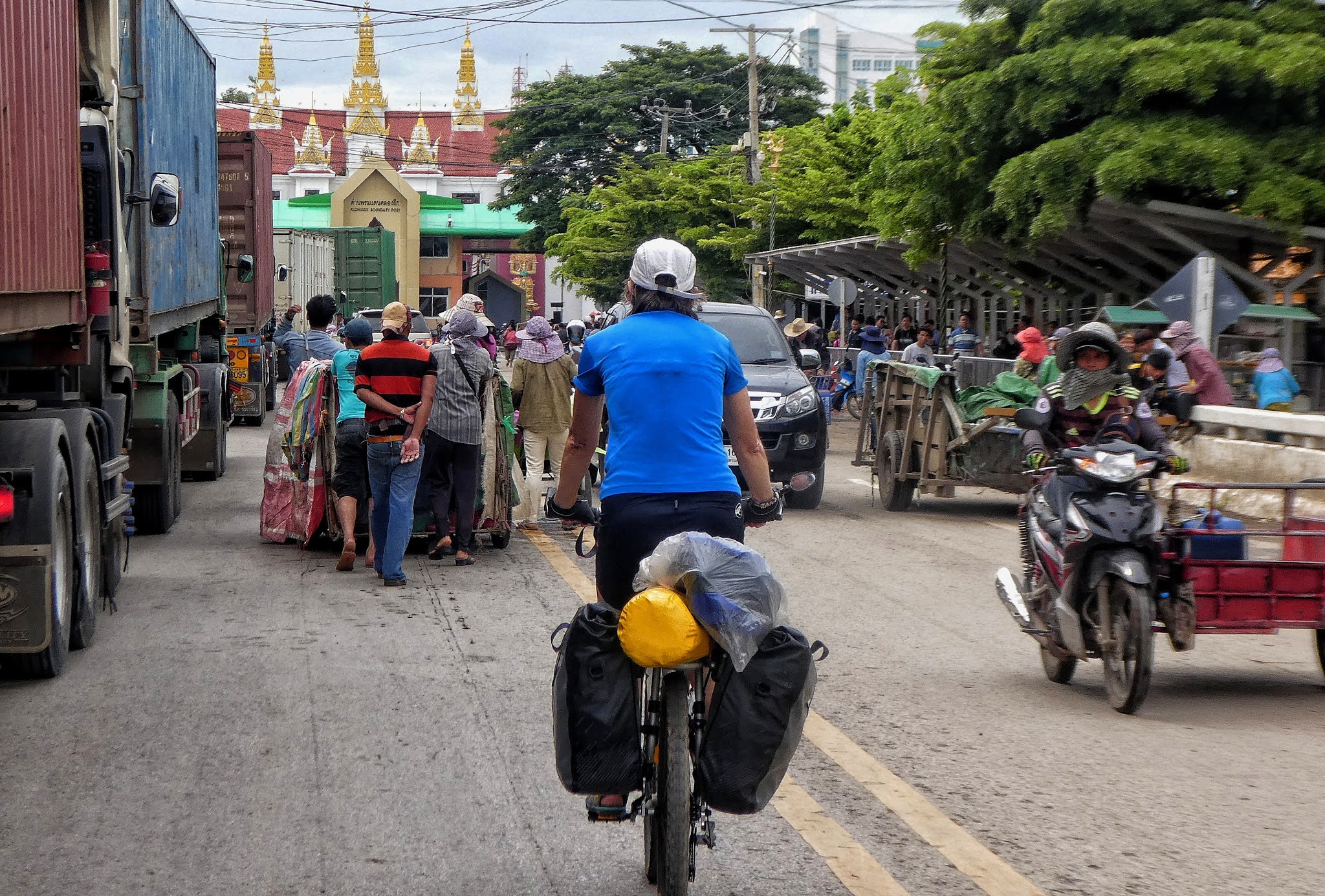
We cycled to the border
where the border market and trade were already in full swing. The area was in complete
chaos with traders in a mad rush to get to the market. We tried our level best
to make our way through the hectic traffic. Eventually making it to the
immigration office. After a quick stamp in the passport, we departed
well-organised Thailand and entered a more chaotic Cambodia.
The entire way was
congested with human-drawn carts, tricycles, three-wheeled motorcycles pulling
heavily laden wagons, trucks, buses, and tuk-tuks all loaded to the hilt. It
took weaving our way through dusty, bumper-to-bumper traffic, dodging barefoot
monks and muddy puddles to the Cambodian emigration. A Cambodian visa came at $30
as per the embassy website. Hundred Thai Baht was nonetheless added to the
price. (The Thai baht, I assumed, was what is known as “spreading the profit”)
From the immigration
office, a good but dusty and congested ride took us east in the direction of
Siem Reap. Numerous eateries lined the way and one such stall sold rice cooked
in bamboo. Sticky rice is mixed with sugar, sweet red beans and coconut milk
and then stuffed into cylinders of hollow bamboo. These tubes are then
slow-roasted over coals, making a delicious snack.
The route made its way
past bright green rice fields, wooden houses on stilts and friendly kids. Stopping
to enjoy coconut juice was a fascinating affair involving meeting super-welcoming
Cambodians. Wrinkly old ladies gave big toothless grins, and small kids shyly
looked from behind their mother’s aprons at the two “farangs” (foreigners) in
their midst. The day consisted of ambling along, marvelling at our new country,
and passing men herding cattle and basic wooden houses where families were
swinging in hammocks under stilted homes.
A sign pointed to a
guesthouse, and to our surprise, we discovered a decent place offering a ground
floor abode at $7. On taking a walk searching for a restaurant, we got plenty
of stares and were observed with great interest. Even though no English was
spoken, we managed to order food.
10-11 August - Roadside
Guesthouse – Siem Reap – 85 km
Before heading to Siem
Reap we first had coffee enjoying the fresh, morning air. The path was shared
with broom and feather duster salesmen. Ornate temples jutted out forests and gave
colour to paddy fields stretching as far as the eye could see. Fruit stands sold
custard apples, and we bagged a few for the road. We biked on passing what we
called “nursery carts” as these carts were stacked with plants and flowers,
apparently heading to a market.
Our midday noodle soup
stop caused a fair amount of interest from bystanders and people brought
children to be photographed. Though, I’d a feeling the kids weren’t all comfortable
with their new role as models.
Overcast weather and a
tailwind made effortless pedalling, past water buffalo enjoying muddy puddles
left by the previous night’s rain, and past ramshackle shops selling cigarettes
and petrol by the litre. A market sold deep-fried snakes, frogs, and crickets.
Caron couldn’t face trying these delicacies, and I merely tried the snake served
with salt and lemon but thought it dry and tasteless.
Siem Reap was a bustling
town swarming with tourists. It thus came as a shock to see the hordes of foreigners,
fancy hotels, and upmarket eateries following a week in the countryside.
The next day was spent exploring
world-renowned Angkor Wat, a fascinating experience.
12 August - Siem Reap –
Sroyorng Koh Ke Guesthouse – 116 km
Cycling out of Siem Reap,
I was surprised to witness child labour. Small kids on bicycles collected empty
bottles to recycle. Being Sunday, I hoped they attended school during the week.
Once out of touristy Seam Reap, the road deteriorated, making a bumpy ride through
potholes filled from the previous night’s rain.
Rather than taking the
highway, we opted for a significantly smaller route, hoping it would lead to
the Mekong River. The ride turned out to be exciting along a dirt track and
through the utmost of rural areas. Villagers still farmed in primitive ways,
lived in nipa huts, obtained water from wells and chewed paan. Ox-drawn carts
carted wares, rice was milled in backyards, and rice paper (used in Vietnamese
rice paper rolls) were made by the entire family. Corn boiled in large pots at
the roadside, and the aroma made it virtually impossible to cycle past. Unfortunately,
our decision to buy what was on offer sent nearly the entire community in
disarray. A few kids ran home, others giggled endlessly, but one brave soul
remained and shyly served the two foreigners. The rain caught us no less than
three times, each shower leaving us sopping wet with steam rising from our
soaked bodies.
The area was nevertheless
delightfully rural, kids played in rivers and jumped off bridges and did what
kids do. Others were cutting rice in paddies, and village dogs made it clear this
was their territory. A pleasant day by anyone’s standards made even more so by
finding a guesthouse in a tiny nameless settlement.
13 August - Sroyorng Koh
Ke Guesthouse – Chhaeb – 110 km
Child monks collected
food as we biked out of the village. Our path twisted and turned through rural
settlements where cattle and buffalo had the right of way. Like the previous
days, our route was shared with two-wheel tractors pulling wooden trollies laden
with produce or entire families. Friendly kids called “hello”, and pyjama-clad
women waved us goodbye.
Motorbike salesmen were carting
piglets in bamboo cages and others woven fish traps. But, highly fascinating was
a mobile separating rice milling machine (not sure what it’s called). It went
from house to house and separated the villager’s rice from the husk.
Fearful kids hid behind
their mothers’ aprons and small dogs ran for their lives, only stopping once
they reached the safety of their homes. This was a clear indication few foreigners
ever ventured that way. The way ran amongst the ever-present luminous green
rice paddies and past small kids, three up, on small bicycles. Finally, towards
the end of the day, Chhaeb rolled into view.
Little English was spoken
in those rural areas. Still, getting a bite to eat was easy. All one needed to
do was repeatedly point your second and middle finger to your mouth (indicating
chopsticks). What was served was often a surprise. This time, it consisted of a
clear broth containing chicken feet, rice, and a meat dish that primarily
included bones. What bones they were, remains a mystery. Still feeling slightly
hungry, we stopped at a stall to pick up a noodle dish. Waiting, Caron ordered
a boiled egg and to her horror, the egg turned out “Balut” - a half-developed
duck embryo. Needless to say, the dogs enjoyed it.
14 August - Chhaeb –
Stung Treng – 86 km
Our first stop was at a baguette
stand. Cambodia’s traditional snack, Nompang (baguette), is filled with slices
of pork, meatloaf, pickled carrots, papaya, and cucumber, topped with coriander
and a pate spread. It’s delicious.
Then, on to our final
stretch to the Mekong. It must be mentioned this was an extremely rural area
where foreigners seldom ventured. Even though friendly, children were, for the
most part, highly apprehensive and kept their distance. Vendors sold meagre
supplies of petrol by the litre, and a few fruit and vegetables from their gardens.
Also sold were birds and other wildlife in cages including a baby monkey who befriended
a dog (as if they knew they were in the same boat as both were for sale).
Still, even the tiniest hamlet
had a pharmacy and a small clinic, consisting of no more than a few bamboo
woven beds. The beds weren’t unusual as, in general, people in southeast Asia
sleep on woven rugs. Soon afterwards, it started raining. A ramshackle stall made
a good cover and place for a tasty barbequed sausage and baguette snack. I considered
it best not to enquire regarding the ingredients. Whilst waiting until the
weather cleared, we watched ladies pounding rice to make tepung, a kind of rice
flour. As in Africa, two women rhythmically pounded rice into fine rice flour
in a large wooden trough using long poles, hypnotic and relaxing watching.
Crossing innumerable
broad rivers and watching skilful fishermen cast their nets, the path crossed the
Mekong River via the modern Stung Treng Bridge. The town sported several guesthouses
and finding accommodation was straightforward. Although right in the market
area, we were unsuccessful in finding food and eventually settled for a fried
noodle dish from a Chinese restaurant.
15 August – Stung Treng –
Krati – 142 km
“Hou boude, hou,”
Caron said when I told her the ride to Krati would be 140 kilometres, the next settlement
along the Mekong. Unfortunately, the area didn’t offer a great deal in line of
accommodation or even temples, and one had little option but to continue. A
bumpy and potholed route led out of Stung Treng. Mercifully, about 40
kilometres later, a brand-spanking-new road, made riding far more comfortable. The
weather was overcast, but a slight headwind slowed our pace.
Even though a challenging
day, it remained a privilege and a pleasure to cycle past small settlements
where cattle, bare-bum kids and buffalo had the run of the village. A lunch of fried
rice from a roadside stall provided much-needed energy.
Basic wooden houses on
stilts, welcoming Cambodians, and laundry flapping on fences became familiar
scenes. For the best part of the day we’d our heads down as we pedalled across enormous
rivers, past rice fields and forested areas until reaching Krati in a slight
drizzle and fading light. Exhausted, and Caron with a sore behind, the Heng
Heng Hotel, right on the Mekong River, was a welcome sight. However, no sooner
settled in, a fierce storm rolled in, rattling windows and doors, and we couldn’t
believe our luck. Once the storm had subsided, hunger pains drove us to a nearby
restaurant where we could choose from an extensive range.
16 August – Krati
We woke to the sounds of
the street and a view of the Mekong River. As we’d plans of tracking down the
rare freshwater river dolphins, there was no rush to go anywhere. A walk
through the market was as interesting and informative as all markets, and it
gave a glimpse into the lives of ordinary Cambodians. Who said pyjamas was purely
for bed? In Cambodia, this comfortable garment has evolved into all-purpose
wear. Pyjamas were worn by Khmer women at all times of day - to markets, on the
streets and even to restaurants. We, therefore, followed suit and Caron bought
herself decent Cambodian pyjamas she planned on wearing riding.
A bumpy tuk-tuk ride dropped
us where boatmen took people across a strong-flowing Mekong River to where we
hoped to catch a glimpse of the river dolphins. Irrawaddy dolphins are
distinctive in that, unlike nearly all species of dolphins with long noses and
pointed features, the Irrawaddy species has a blunt nose and straight mouth,
rounded tail and fins. In addition, they don’t jump like other dolphins, and
one had to look closely to see them. It’s said that these dolphins are
genetically related to the killer whale (orca). How interesting! Although
called the Irrawaddy River dolphin, I understood that they are not actual river
dolphins. Instead, they are oceanic dolphins living in brackish water near
coasts, river mouths, and estuaries. It has established subpopulations in
freshwater rivers, including the Ganges and the Mekong. These dolphins are
highly vulnerable as the worldwide population appears around 7,000. Another
interesting fact is that they are almost blind. They have tiny eyes and even
lack lenses and can do little more than distinguish between light and dark.
What a fascinating world we live in! Finally, with threatening weather, our
boatman returned to the safety of the shore.
17 August - Krati –
Police station – 83 km
From Krati, a narrow,
rural track ran along the Mekong, a beautiful ride through small settlements on
the river banks. Flooding is a way of life along the lower Mekong. In August/November,
monsoon rains fill the river, spilling over into adjacent farmlands. Our route
was chock-a-block with livestock, laundry and children; all brought to the elevated
road for safety. If your house wasn’t on high stilts, things were sure to become
wet. Schools, temples, mosques and even clinics were all under water. Yet, no
one seemed stressed and kids enjoyed the abundance of water.
Pyjama-clad women sat in
doorways nursing babies or playing with toddlers. At the same time, men on
haunches fixed fishing nets and bamboo chicken cages. Eateries moved onto the
slightly elevated road which made convenient pickings. The path meandered
through the chaos until reaching where the map indicated a guesthouse. Regrettably,
the place didn’t exist and at the temple, monks pointed us to another temple. The
temple was a busy one occupied by child monks and village kids. Understandably,
they were inquisitive, but this well-meaning attention was overbearing to us.
In the process, a kind Cambodian offered accommodation in his house but, again,
we found sharing sleeping quarters with an entire family too close for comfort
and continued to where we came upon a police station. Helpful staff phoned the
“director” who gave the necessary permission. After presenting our passports
and lining up for a photo (which made us feel and look like two criminals), the
staff pointed to a vacant office. Under scrutiny, we swept the office and rolled
out our sleeping mats. Our every move was watched until we eventually indicated
our need for privacy and our hosts returned to their office. Caron wasn’t too
happy sharing our spot with frogs, crickets, grasshoppers and geckos and once
they were gently helped outside, we settled in.
18 August - Police
station – Kampong Cham – 48 km
Caron claimed she slept keeping
one eye open, watching for our four-legged “roommates”. Following a photoshoot,
we cycled south in the direction of Kampong Cham. Still early, we found villagers
going about their daily tasks. Kids were off to school, and ladies in pyjamas
sold fried dough from the back of bicycles, which made a great snack cycling.
Like the previous day,
low-lying areas were flooded, sometimes only rooves of barns or houses could be
seen. Kids loved it and had a ball playing with anything that would float. The
slightest elevated areas were used to dry produce, cook or keep chickens and
cattle out of harm’s way. As grazing areas were flooded, feed was collected
elsewhere, and ladies on bikes carted animal feed. At the same time, men toiled
the land using oxen. The river trail was one of my favourite rides, and
thoroughly enjoyable as we made our way to sleepy Kampong Cham. The evening was
spent strolling along the riverfront in the company of the people from Kampong
Cham, as this was where they hung out at sunset.
19 August – Kampong Cham
–Phnom Penh – 110 km
From Kampong Cham, a
small track took us along the river and went past people living on barges; several
even had small gardens. Ladies were dyeing silk (used in weaving) or were drying
grasses in the sun. These colourfully dyed grasses made pretty pictures as well
as beautiful mats. Salesmen stacked high sold wares from door to door and bicycles
piled equally high with animal feed were on their way home. Small kids, no more
than four or five years old, gave friends a ride on their tiny bikes. Their
balance on a bicycle is extraordinary.
Due to flooding, our route
ended abruptly, forcing us to find an alternative path. Unfortunately, a
typical monsoon storm came in. We pulled into the nearest sheltered area, only
to find it a private house. In typical Cambodian style, the family welcomed us
and offered chairs to wait out the weather.
Once the worse was over,
we set out anew, soon reaching the highway leading into Phnom Penh. Being Sunday
afternoon, we’d an (almost) leisurely ride into the city. Once at Grand View
Guesthouse, I was delighted to meet my adorable friends Chop, Matthew,
Phillipe, Nic and a few others.
20-21 August - Phnom Penh
Priority was to obtain a
Vietnamese visa and a tuk-tuk ride took us to the Vietnamese embassy merely to
find it closed. There was zero one could do and we returned to our abode. Caron
visited the killing fields and the old S21 detention centre. I chatted to my
friends and caught up on outstanding matters. We handed over our passports to a
visa agency as we had limited time available. At a small fee, they arranged a
Vietnamese visa in 24 hours. During our stroll along the riverfront, we were
cajoled into a sunset cruise and at $5 pp, we were easily swayed. The evening
turned out lovely as the boat slowly sailed upriver at sunset and we, glass of
wine in hand, sat back and enjoyed it all.
The next morning, we
searched for dumplings uncovered outside the central market. Afterwards, we felt
well-fed and strong enough to brave the market. We weaved through a labyrinth
of stalls in the hunt of nuts and other delicacies to concoct a snack to eat during
the day. Tickets were bought to that evening’s traditional dance show which made
a lovely evening out.
22 August — Phnom Penh —
Angkor Borei (Borey) — 91 km
Getting out of Phnom Penh
was easier than anticipated. The initial plan was to head to Neak Loeung, but
20 kilometres outside the city, a change of plan made us head to Angkor Borei. A
stunning ride proceeded through a seldom visited and rural part of Cambodia.
The way varied from exceptionally rough and potholed to smoothly paved. Just as
one became used to the comfort of a paved road, it abruptly ended and turned
into a rough dirt track past duck farms and people on motorbikes laden with
bananas. These motorbikes were fitted with frames allowing transporting a maximum
load. At a water stop, the owners promptly invited us in and even offered
accommodation. Too early to call it a day we continued to where a ferry took people
across the Tonle Bassac and continued on a rough track, past farmers drying
rice.
Certain crops were ready to
be harvested, others were planted more recently. Lunch was at the small community
of Prey Lovea, and then on to Angkor Borei an area continuously inhabited for at
least 2500 years. Artefacts unearthed in the area dates from the Neolithic
period between the 4th - 5th century AD and the Angkorian period (9th - 15th century
AD). Nevertheless, there was no sign of its past glory. In tiny Angkor Borei finding
a guesthouse was easier than food, eventually, we settled for ordinary fried
noodles, but would’ve been happy with almost anything dished up.
23 August - Angkor Borei
- Kampot
From Angkor Borei, we
understood a boat ferried people to Takeo, saving biking a long distance around
the lake. Since no one spoke English, the procedures or time weren’t entirely
clear. The lady at our digs spoke a little English, and reported a boat departed
at 7h00. Adjacent to the temple, we located a slipway and the official Angkor
Borei/Takeo ferry. Once the bikes and panniers were loaded, more passengers
started arriving. We claimed the front seat and waited until the boat filled up.
No sooner were the boat underway
when the engine cut out, leaving the boat adrift. Thankfully, they simply wanted
to drop a passenger. The skipper sped across the lake at high speed, drenching the
two unsuspecting “farangs”, and we then understood why others filled the boat
from the back. Barely an hour later, we arrived in Takeo, soaking wet.
A slow leak made me stop
at a bicycle shop to buy a new inner tube as I’d neglected to fix the punctured
ones. The shop had none in stock, and I started fixing the old tubes, a job the
owner took out of my hands as he most likely thought I’d no idea what I was
doing. I didn’t resist, and he fixed both tubes. He wanted no payment and
further supplied us with a stack of patches. Before cycling out of Takeo, breakfast
was pork pau and iced milk tea, usually delicious. Still, we were served a glass
of condensed milk over ice. Even though strange, we drank it anyhow. The owner subsequently
showed us we were to add the tea (already on the table) to the milk! He most
likely thought, “Stupid foreigners, which we were”. Being already late, we made
our way to the main road which took us in the direction of Kampot.
The path followed was a
rough one and once on the main road the going was considerably easier. Battling
a headwind and becoming drenched on three occasions made slow progress. The
rain was a blessing to the farmers, and rice paddies were filled to the brim.
It’s never a pleasure riding into a headwind, and we had 70 kilometres of that.
Little did we know the worse was still to come.
Approximately 18
kilometres from Kampot, the road deteriorated to such an extent it became
easier to cycle next to it. Traffic snaked around potholes as best they could, a
futile attempt as ongoing roadwork made it one giant pothole and, therefore, a
dusty and slow affair.
Thrilled to arrive in
Kampot, we headed across the river to Riverside Bungalows, where guests laughed
at our dirty, dusty faces. On removing our shades, we resembled two Silverleaf
monkeys. Following a shower, it was time for a well-deserved beer and a massive
plate of food.
24 August – Kampot
Kampot River Bungalows was
an ideal place to enjoy a day of leisure. Situated in a jungle-like setting, it
featured nipa huts on stilts overlooking the river. It made a peaceful and tranquil
location. Cabins were extremely basic and airy, but mercifully came with
mosquito nets.
Inner tubes made perfect
toys with which to float on the river. The restaurant deck extending over the
water was an excellent place to while away the time. Later, a short cycle led
into Kampot, and once stocked up on snacks, we returned to our little haven. Supper
was on the deck overlooking the river. Life was indeed good behind the potted
plants.
132 Vietnam
(4)
483 Km – 6
Days
25 August - Kampot,
Cambodia – Ha Tien, Vietnam – 75 km
From Kampot, and on a
bumpy, dusty route, the way to Vietnam weaved through rice paddies, palm trees
and basic houses under corrugated iron roofs, to the small seaside village of
Kep. From Kep, we made our way along a rural path to the border through an area
where the air smelled of cow dung, and typical homes kept cattle in front yards.
Nevertheless, our last day of riding in Cambodia was a relaxing one watching ladies
cutting rice and kids collecting snails in rice fields.
The Hungry Ghost Festival
was being celebrated and shrines were stacked with tins of beer and cigarettes.
At the full moon of the seventh lunar month of the Chinese calendar, it’s believed
the gates of hell open, and spirits of hungry ghosts are allowed to roam Earth.
Naturally, these ghosts need food and people help by offering food, paper
money, candles, and flowers. We watched villagers burning paper offerings in an
attempt to appease the ghosts.
On arrival at the
Cambodian/Vietnam border, crossing into Vietnam was a smooth affair. Our first
stop was at a cave temple, reached following climbing a few stairs. The cave
was surprisingly airy inside and offered grand vistas of the surrounding
landscape.
Our first town in Vietnam
was one with a fascinating history. Way back, Ha Tien was a Cambodian province.
Still, under the attack of the Thai’s in 1708, the then-governor, Mac Cuu,
approached Vietnam for assistance. Assistance was granted after which Mac Cuu
governed the area as a fiefdom. Sadly, this wasn’t the end of their struggle. Since
then, they’ve been invaded by Thais on several occasions and came under attack
during the American war and during the reign of the Khmer Rouge, who massacred
thousands of civilians living in Ha Tien at the time. Today, though, Ha Tien is
a peaceful town sporting a lovely river setting, a lively day market, and an interesting
night one.
Trying to change money
was easier said than done, as no one spoke English and banks were closed. However,
one could typically get a better rate at the gold shops. With a whopping
2,000,000 Vietnamese Dong (approx. $85) in our pockets, we felt rich and booked
into an establishment right on the river.
26 August — Ha Tien —
Chau Doc — 103 km
It was a pleasure to wake
to the sounds of the street and the general mayhem of the market. I sipped my
first cup of coffee listening to ferries blowing their horns before departing to
the islands - a pleasant way to greet the day. Before getting underway breakfast
was at the market. It consisted of a typical Vietnamese Pho (noodle soup), the
first of many.
Our path followed a canal
close to the Cambodian/Vietnam border and a way congested with motorcycles and
minivans running to and from Cambodia. It, nevertheless, remained a pleasant
ride, and rains transformed the delta into what looked like an ocean. At times,
the canal completely disappeared, but amazingly boats still managed to find
their way. River transportation was alive and well in Vietnam, and so was the farming
of birds’ nests. These edible birds’ nests are created by swiftlets using their
saliva to build them. The nests are extremely popular in Chinese culture not unlike
caviar in the west. Its popularity is due to its rarity and supposedly high
nutritional value and flavour. I subsequently read, these nests are among the costliest
animal products consumed by humans, with nests selling at prices up to US$3000
per pound, depending on grading. With those numbers in mind, it’s
understandable why farmers build massive structures specifically for these
birds to nest.
Roadside markets sold
woven baskets and mats, and peasants collected plastic bottles and tins to
recycle. In Vietnam, eateries came with tables and chairs and a considerable number
of hammocks, as it is unthinkable to sit when one could lay, which made
complete sense. We followed suit, kicked back in a hammock, and replenished our
thirst with coconut juice.
With the recent flooding farmers
had nowhere to dry their rice crops. They used the tarmac, forcing vehicles
over it to assist in the threshing process.
The Ba Chuc memorial was a
grim reminder of the horrors perpetrated by the Khmer Rouge. In April 1978, the
Khmer Rouge killed 3157 villagers in Ba Chuc; only two survived. A depressing
visit. Outside, a lady sold what I would call Vietnamese pizza (Banh Trang
Nuong). It consisted of rice paper grilled on coals and topped with chilli
paste, quail eggs, spring onions, and minced pork. Delicious.
The trail petered out
altogether forcing us to return to our original route. Caron was a star and
never complained once about the detours or terrible conditions. Once in Chau
Doc, the comfortable Thuan Loi Hotel right on the river was a perfect choice.
27 August - Chau Doc –
Cao Lanh- 75 km
Our balcony overlooked
the Bassac River, a perfect vantage point to watch all happenings. Not simply
did large boats move up and down the river, but people rowed kids to school or
themselves to work or markets. All this happened whilst the river was in full
flood, and one could only be amazed at the skilful way they did it. Our route left
via a small path and we made our way along one of the many canals. In the
process, we passed ladies under straw hats pushing carts laden with fruit and
vegetables from door to door.
The delta is a watery world. Here,
the Mekong River drains into the South China Sea, ending its 4,350 km journey
from Tibet through Myanmar, Laos, and Cambodia. No less than four times ferries
were required to get across the many waterways and canals, all making an unforgettable
day. Roads were generally tiny and villages small and rural, and the larger
ones were congested with motorbikes and scooters.
Having a bite to eat at a
restaurant, I was surprised to see a man and his chicken having lunch. I’m not
kidding you. There he was, with his chicken sitting next to him on a chair. On his
departure, he tucked the chicken under his shirt, got on his motorbike, and
sped off. A river trail ran along the canals from our lunch spot, making a good
day on the bike.
28 August - Cao Lanh –
Vinh Long – 70 km
“I think we’ve doubled
the tourist count of Cao Lanh,” Caron said as we sat down to an excellent bowl
of Pho. Pho is a Vietnamese soup consisting of broth, rice noodles and meat and
is considered Vietnams national dish. Ambling along, we were perplexed by the
drying of water hyacinth. As far as I was aware, barely any use existed for
this extremely invasive and free-floating aquatic plant. I couldn’t imagine what
it could be used for.
The Xeo Quyt forest was a
magnificent 52-hectare forest and swamp. I understood it was one of the last
natural forests in the Mekong Delta. During the Vietnam War (1955-1975), the
area was used as a base, and today it hides the remains of Viet Cong bunkers. Paddling
through a thick canopy of trees past remains of war relics made fascinating exploring.
Moreover, it gave a tiny glimpse into the lives of Vietnamese during that time.
Finally, I discovered the
use of dried hyacinth. Resourceful Vietnamese were using it to weave baskets
and various other products. After ice cream, we turned our iron horses in the
direction of Vinh Long. Once there, we opted for a short ferry ride to an
island where a homestay owner showed us the way to his guesthouse. The evening
turned out interesting as the establishment was brand-new, and still in the
process of being built.
29 August – Mekong River
Homestay – My Tho – 85 km
Breakfast included a
delicious cup of Vietnamese coffee; the best had until then. We wished the
family good luck with their new venture and cycled to the ferry. The boat was
packed with farmers and traders taking produce to the market. It was
astonishing to watch the skilful way they manoeuvred their motorcycles onto and
off the ferry.
Our route continued along
a river, passing villagers selling simple homemade nibbles. Others were
winnowing rice the old-fashioned way or drying homemade sausage in the sun. Beautiful
temples and interesting-looking brick-making structures made interesting
detours. Each area in the delta produced a different crop, and we were very
much in the area of dragon fruit plantations.
The delta came with countless
ferry crossings and bridges. Rivers were busy waterways, and all boats had eyes
painted on the bows. Fishermen and seafarers of all countries are superstitious,
and the Vietnamese were no exception. Some say the eyes are intended to help
the boats at sea find their way back to land. Others say the eyes are meant to
scare off sharks or water monsters or are meant to bring good luck and fortune.
Several fishermen believe their boats are like fish – with souls and eyes to
steer clear of danger. Whatever their purpose, eyes adorned boats, both big and
small. I understood painting eyes on a ship was an important ritual often
associated with a ceremony to “open the eyes” of the vessel and bring it to
life. I could relate to this as back home, before a dragon boat race, a
ceremony known as “Awakening the Dragon’” or “Dotting of the Eye”, was
performed, thus ending its slumber.
On arrival in My Tho, a
helpful man pointed us to a budget hotel right across from the night market. It
suited us perfectly and once showered, we hurried to the food court, where one
could sit overlooking the river. Watching the Mekong flow past was a fitting
end to the day and our ride through the delta.
30 August - My Tho –
Saigon – 75 km
Breakfast was a pavement
bánh mì (Vietnamese baguette). There was banh mi stands on practically all streets
in Vietnam. The baguette featured crispy bread, with a tasty filling of sliced
pork, pate, chicken, egg, spicy chilli sauce and herbs. We ate our baguette,
dripping sauce over ourselves and the pavement (I don’t know how the Vietnamese
do it), watching the horrendous morning traffic. Then, with full bellies, we
joined the mass of motorbikes and resumed our ride out of My Tho. The ride
turned out more pleasant than expected as we encountered rural paths leading virtually
all the way to Saigon.
The route led through
farming communities where women with conical hats sat on their haunches
cooking. Chickens pecked in the dirt and men carted huge piles of hay on small
motorcycles. The aroma of homemade food drifted across our path as school
children headed home to have lunch. Our route meandered through dragon fruit
plantations until reaching the city limits. We joined the eight million
motorbikes in Saigon, into the city. Following suit, we didn’t look left or
right and ignored red lights and road signs, eventually reaching downtown. In
one of the alleys, we located Hai Guesthouse with a spacious room and large
balcony. The strange thing was virtually everyone referred to the city by its
old name “Saigon”, instead of TP Ho Chi Ming city. The only one’s referring to
it by its proper name seemed the officialdom.
Sadly, this was the end
of our journey. From Saigon, Caron returned home, and I’d to make a beeline to
Thailand. I planned to meet my friend, Linda, in Bangkok, as she was coming to
Asia to cycle Myanmar. It was a pleasure cycling with Caron, and I hope she
enjoyed her time in Southeast Asia. Go well, my friend.

%20&%20Thailand%20(15).jpg)
